Sunday, January 27, 2013

Matthew 27 - The King is Crucified

LINK: Matthew 27


BACKGROUND

From: The Bible Knowledge Commentary New Testament, p. 84
Friday at Dawn

Religious Trial Three


228. The council of religious leaders condemns Jesus: Matthew 27:1-2, Mark 15:1, Luke 22:66-71

Luke's account of this event gives the most detail. At daybreak (because it was illegal to meet at night), Jesus was led to the third Jewish trial before the Sanhedrin (council of elders). They were the official judicial body of the Jewish nation. It was also considered the final court of appeals. Jesus said He was the Son of God and would be seated at the right hand of God. Jesus was pronounced GUILTY of blasphemy. Now, Jesus had to be handed over to the civil court of the Romans because the Jews were not allowed to sentence anyone to death. The leaders refused to believe; just as Jesus said.

229. Judas hangs himself: Matthew 27:3-10

Matthew is the only gospel writer who records the suicide of Judas. He felt remorse and did not want the money he was paid (the price of a slave, Exodus 21:32), but the priest could not use tainted money (Deuteronomy 23:18). Acts 1:18-19 adds more details to the story of Judas. So sad. See the prophecies in Zechariah 11:12-13 and Jeremiah 19:1, 4, 6, 11.

Civil (Roman) Trials

After Dawn

230. Jesus' trial before Pilate: Matthew 27:11-14, Mark 15:2-5, Luke 23:1-5, John 18:28-37


Trial Four (First Roman)

John's account is the most detailed of the four gospel accounts.

Even though the religious leaders had passed judgment on Jesus, only the Romans could exercise capital punishment. So, the case was brought to Pontius Pilate, the Roman procurator (governor) of Judea and Samaria from A.D. 26-36 (Luke 3:1), who was in Jerusalem because of the Passover feast. During the great feasts, rioting, and insurrection were more common, especially during Passover when the Jews remembered their deliverance from bondage to the Egyptians. 


Pilate and the Jews obviously had a hostile relationship. Pilate refused to do anything with just a charge of blasphemy. The Jews could not execute Him by stoning because prophecy had already said that no bones would be broken (Psalm 34:20). Also, He had foretold that He would be "lifted up" like a "snake in the desert" (John 3:14; Exodus 21:9). Jesus had to die by crucifixion and only the Romans could do that. 


The religious leaders brought Jesus to Pilate with three accusations, but Pilate only concerned himself with the third: Jesus' claim to be king. This was the only one that would be any threat to Rome, but after questioning, Jesus assured Pilate that He was a king, but of a kingdom not of this world (John 18:33-37). Pilate declared Jesus guiltless (Luke 23:4); when he found out He was a Galilean, Pilate sent Jesus to Herod to be tried. 

There is a second Roman trial before Herod Antipas, but it is only recorded in Luke 23:6-12. 

232. Pilate hands Jesus over to be crucified: Matthew 27:15-26, Mark 15:6-15, Luke 23:13-25, John 18:38-19:16

Trial Six (Third Roman)

Pilate wanted to punish and release this innocent man (Mark 23:16), but the crowd was stirred up by the religious leaders, and he was pressured to release Barabbas, an insurrectionist (John 18:40) and murderer (Mark 15:7) instead. 


John is the only writer that covers the flogging (leather whip with bits of metal at the ends which often killed people), the crown of thorns, purple robe, ridicule as King of the Jews, and beating. 


Pilate wanted to release Him but the Jews convinced him that if Jesus claimed to be king he was opposing Caesar. Their cry was for crucifixion, and Pilate took water and washed his hands symbolizing that he wanted to absolve himself of putting an innocent man to death (Deuteronomy 21:6-9). Then he released the murderer and handed the innocent Jesus over to be crucified. 


The events leading up to the crucifixion are more detailed in the Matthew, Mark, and Luke accounts, but the actual crucifixion is more detailed in John's gospel account. 

233. Roman soldiers mock Jesus: Matthew 27:27-31; Mark 15:16-20; Luke 23:36

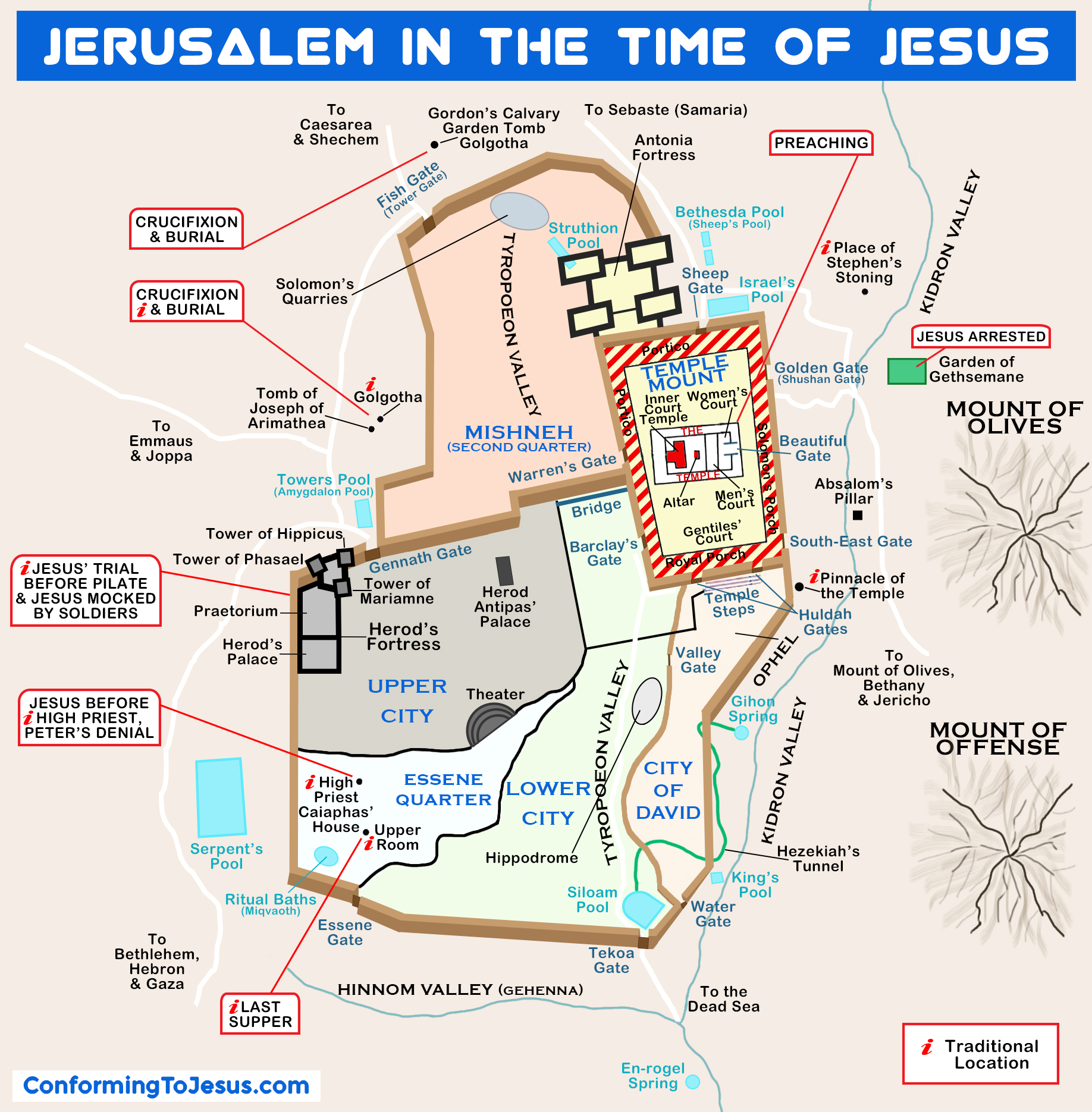
A whole Roman cohort of 600 soldiers was gathered for this event. The Praetorium would have been large enough to fit them. It may have been in Pilate's residence at the Castle of Antonio or Herod's palace. 

Roman soldiers were known for their cruelty. So, Jesus was probably beaten badly. This fulfilled Isaiah 52:14 which says that His appearance was marred more than any man. He bore this suffering without a word (1 Peter 2:23).


234. Jesus is led away to be crucified: Matthew 27:32-34; Mark 15:21-24; Luke 23:26-31; John 19:17

Jesus is on His way to Golgotha. Just as Isaac carried his own wood for the sacrifice in Genesis 22:1-6 and the sin offering was taken outside the camp or city (Hebrews 13:11-13), the John account says that He carried His own cross. The other accounts state that Simon of Cyrene carried the cross part way. Here is an interesting perspective on why that happened: 
It was a part of the prisoner’s humiliation that he carry his own cross to the place of execution, so when Jesus left Pilate’s hall, He was carrying either the cross or the crossbeam (John 19:17). 
Apparently, He was unable to go on, for the soldiers had to “draft” Simon of Cyrene to carry the cross for Him. (This was a legal Roman procedure. See Matt. 5:41.) When you consider all that Jesus had endured since His arrest in the Garden, it is not difficult to imagine Him falling under the load. But there is something more involved: carrying the cross was a sign of guilt, and our Lord was not guilty! Thousands of Jews came to Jerusalem from other nations to celebrate the feasts (Acts 2:5–11), and Simon was among them. He had traveled over 800 miles from Africa to celebrate Passover, and now he was being humiliated on a most holy day! What would he say to his family when he got home? 
What looked to Simon like a catastrophe turned out to be a wonderful opportunity, for it brought him in contact with Jesus Christ. (By the way, where was the other Simon—Simon Peter—who had promised Jesus to go with Him to prison and to death?) Simon may have come into the city to attend the 9 a.m. prayer meeting in the temple, but the soldiers rearranged his schedule for him. 
We have good reason to believe that Simon was converted because of this encounter with Jesus. Mark identified him as “the father of Alexander and Rufus” (Mark 15:21), two men that Mark assumed his Roman readers would know. A Christian named Rufus was greeted by Paul in Romans 16:13, and it is possible that he was the son of Simon of Cyrene. Apparently Simon and his two sons became well-known Christians who were held in honor in the church. 
Before Simon met Jesus, he had religion and devotion; but after he met Jesus, he had reality and salvation. He did both a physical and spiritual “about face” that morning, and it transformed his life. God can still use unexpected and difficult situations, even humiliating situations, to bring people to the Saviour.  (The Bible Exposition Commentary, Lk 23:26)
On the way to Golgotha, the Luke account records His warning to the people of the persecution that was to come (Hosea 10:8; Revelation 6:15-17). 

The Third Hour (between 9 am and noon)

235. Jesus is placed on the cross: Matthew 27:35-44; Mark 15:25-32; Luke 23:32-43; John 19:18-27

Crucifixion was widely practiced by the Phoenicians and Persians but Roman law permitted its use only on slaves and non-Romans. In Israel this shameful and excruciating punishment was inflicted for crimes of robbery and sedition and served as a public reminder of the Jews' servitude to Rome.  (The Daily Walk, October 9, 2008, p. 14)

Mark 15:25 says Jesus was placed on the cross at the third hour which starts at 9 a.m. (Mark 15:25). While John 19:14 says He was handed over by Pilate "about noon." Josh McDowell offers two possible explanations:
The night was divided into four watches, each consisting of three hours (see Mark 13:35), and the day was to some extent likewise divided into periods. In light of this, we can imagine that Mark’s statement about the “third hour” simply meant that Jesus was crucified sometime during the third hour (between nine o’clock and noon), while John’s statement that the trial ended about noon can mean before noon.  
Another possibility is that John is using a different method of reckoning time than Mark. We know for a fact, from Plutarch, Pliny, Aulus Gellius, and Macrobius, that the Romans calculated the civil day from midnight to midnight, just as we do today. 
Thus John’s “sixth hour” would be six o’clock in the morning. This would make 6 a.m. the time of the last of the trials of Jesus, and of His sentencing, giving adequate time for the events leading up to the crucifixion which, in Mark, was at 9 a.m. or afterward. 
There is good evidence that John used this method of computing time. This is not unusual in Scripture to have different authors use different methods of measuring time and determining dates. http://www.josh.org/resources/study-research/answers-to-skeptics-questions/dont-the-gospels-give-contradictory-reports-as-to-the-time-christ-was-crucified/

He had two criminals on each side (Luke 23:33). He said seven things as He was crucified, and I will summarize them at the end, but His first prayer was that the Father would forgive them for what they were doing (Luke 23:34).

The dividing of His garments fulfilled Psalm 22:18 (John 19:24). Pilate continued the game with the Jews by writing that Jesus was "KING OF THE JEWS" so that all languages could read it (John 19:19-22). As He hung there, He was mocked by people passing by, the religious leaders, soldiers, and even the robbers being crucified with Him (Matthew 27:39-44, Mark 15:29-32, Luke 23:35-39). The Luke account adds that one of the robbers defended Jesus and asked to be remembered in paradise, and Jesus told him this would happen (Luke 23:39-43). Notice that the Luke account was the only one that recorded Jesus asking the Father to forgive them. The Bible Knowledge Commentary says, "Luke's purpose . . . was to show that Jesus was the forgiving Messiah even as He died" (Comments on Luke 23:32-43).

John's gospel is the only account that reports Jesus' conversation regarding His mother's future care (John 19:26-27).  

12-3 pm

236. Jesus dies on the cross: Matthew 27:45-56; Mark 15:33-41; Luke 23:44-49; John 19:28-37

There was darkness from the "sixth to the ninth hour" or noon to 3:00 p.m. (Mark 15:33). How appropriate that Jesus would become the sin-offering for all mankind (John 1:29; Romans 5:8; 2 Cor. 5:21; 1 Peter 2:24; 3:18) during this time of darkness. Just as there were three days of darkness before the Passover in Egypt (Exodus 10:21-23), this Lamb of God died for our sins so that the righteous wrath of God would "pass over" those who put their faith in Jesus (Romans 3:25-26).

He was forsaken by the Father (Psalm 22:1; Matthew 27:46; Mark 15:34) because He took on the world's sin. The Holy Father could not look upon His Son who had become sin and been made a curse for us (Galatians 3:13). 

When Jesus cried, they thought Jesus was calling for Elijah because the Greek word for "Elijah" sounds like "Eloi" (Mark 15:34-35).  

At the end of that time, Jesus cried out to the Father that it was finished (Psalm 31:5), and He gave up His spirit. Papyri tax receipts during that time had this Greek word for finished written across them, and it meant "paid in full."  He had paid the debt for our sin in full (2 Corinthians 5:21)!

Matthew, Mark, and Luke record the curtain of the temple being torn in two. This curtain was between the Holy place and the Holy of Holies in the temple (Hebrews 9:2-3). This curtain was 15 by 15 feet with a linen curtain during the time of the Tabernacle but was 20 feet wide by 60 feet long and 4 inches thick in Herod's temple during Jesus' time. Needless to say, it was a very thick curtain and ripped from top to bottom signifying God did it rather than men (who would rip it from the bottom if they even could). If you have been studying in the Bible Book Club, you know that only the high priest could go into the Holy of Holies once a year (Leviticus 16:1-35). This event signified that everyone had access into God's presence all the time (Hebrews 10:14-26) without the aid of temples, priests, altars, or blood sacrifices! It truly was finished! Our debt was "paid in full"! WOOHOO!

Matthew records that there was an earthquake (Matthew 27:51). This was probably for his Jewish audience. This earthquake recorded at the cross was similar to what happened on Mount Sinai when God gave Moses the Law that included all the regulations for the Tabernacle and its sacrifices (Exodus 19:16-31:18). Hebrews 12:18-24 implies that the earthquake at the cross signified that Christ met the demands and curse of the Law and that He, as the mediator of a new covenant, abolished it forever.  WOOHOO!

The New International Version suggests that the bodies of the saints were raised immediately, but the New American Standard Bible (literally interpreting the Greek word for word) directly says they were raised after the resurrection (Matthew 27:51). 

These events (and the fact that Jesus had the energy to cry out at the end of His crucifixion) caused the Roman centurion to exclaim that Jesus was the innocent (righteous) Son of God (Matthew 27:54; Mark 15:39; Luke 23:47) and the multitudes to beat their breasts (Luke 23:48) while the women who followed Jesus looked on from a distance. These women included Mary Magdalene who had been delivered of seven demons (Luke 8:2), Mary the mother of James and Joses who also was at the tomb on Resurrection morning (Matthew 28:1; Mark 16:1), and Salome, the mother of James and John, who had asked for special thrones for her sons (Matthew 20:20-21). The only disciple recorded as being at the cross was John (John 19:25, 35). 

John's gospel was the last to be recorded, and at that time Gnosticism and Docetism were a problem. Both these ideologies denied the reality of the Incarnation (God coming in the flesh) and His death. The details about His unbroken bones (usually Romans broke bones to speed up the death), blood, and eyewitnesses probably helped with these false ideologies.  In addition, the true Passover Lamb did not have any of its bones broken (Exodus 12:46; Psalm 34:20), and the piercing of His side by the Roman soldier fulfills Zechariah 12:10. 

Here is a summary of Jesus' sayings on the cross:
1) Prayer of forgiveness (Luke 23:34)
2) Promise to the repentant criminal (Luke 23:43)
3) Provision for His mother (John 19:26-27)
4) Cry of separation from the Father (Matthew 27:46; Mark 15:34)
5) Acknowledgement of thirst (John 19:28)
6) Cry of accomplishment (John 19:30)
7) Cry of resignation (Luke 23:46) 
(The Harmony of the Gospels, p. 242)
3 pm - Sunset


Luke records Joseph of Arimathea (a secret believer, Luke 23:51; John 19:38) asking for Jesus' body, but John is the only one who records the involvement of Nicodemus (John 3). This is significant because the bodies of criminals were usually discarded. The linen and spices followed the burial customs of the time.

The preparation and placing of the body in the tomb were probably done quickly since it would have to be completed before the Sabbath at sundown on Friday. It was also the first day of the Feast of Unleavened Bread.

Note that the women followed Him all the way to burial, but the disciples had all abandoned Him (Matthew 26:56). Let's hear it for the women! :)

238. Guards are posted at the tomb: Matthew 27:62-66

On the Sabbath (Saturday), the religious leaders wanted to make sure that no one would steal the body and "fake" His resurrection. Note they called Him the "deceiver," but they were both deceived and deceivers themselves!

REFLECTION/APPLICATION

We will go through four "Good Fridays" between now and the official Good Friday. Please use this day to ask God to search your heart for any sin in your heart and to thank Jesus for being our sin offering.

PRAYER

Search us, O God, and know our hearts;
Try us and know our anxious thoughts;
And see if there be any hurtful way in us,
And lead us in the everlasting way (Psalm 139:23-24).

Thank You Jesus for being our sin offering and our High Priest so that we might have access into God's very presence. Amen. 

Saturday, January 26, 2013

Matthew 26 - The Garden, Arrest, and Jewish Trials


LINK: Matthew 26

BACKGROUND 


Tuesday of Holy Week


207. Religious leaders plot to kill Jesus: Matthew 26:1-5, Mark 14:1-2, Luke 22:1-2

It is two days before the Passover and unleavened bread (I place this at Tuesday, but some commentators think this is Wednesday), and the religious leaders have decided to arrest and kill Jesus, but their sly plan was to wait until the religious pilgrims from the Passover feast had gone home. 


182. A Woman Anoints Jesus with Perfume: Matthew 26:6-13, Mark 14:3-9, John 12:1-11

Chronologically, this event happened before Jesus rode into Jerusalem on a donkey, but the gospel accounts by Matthew and Mark place it here and can only be explained as a flashback. Some commentators believe it was put here in the Matthew and Mark accounts to contrast the worship of Mary with the hostility of the religious leaders or to show why Judas was so interested in obtaining more funds. John’s account is in the correct place chronologically (John 12:1-11).

This event draws Jesus' public ministry to a close. Mary's anointing of Jesus signified her anointing for the coming sacrifice of Jesus on the cross. This is not to be confused with the account in Luke 7:36-50, where the sinful woman anointed Jesus in the house of Simon the Pharisee in Galilee. The anointing in this event is by Mary, probably the sister of Lazarus and Martha, a virtuous woman. Sometimes people are confused because both events happened in the home of a man named Simon, which was a common name in those days.  

It is six days before the Passover. Some gospel harmonies place this day as Friday and some as Saturday before Palm Sunday. People would arrive early because of the large number of pilgrims coming for ritual purification before the feast.  Jesus has just returned from Ephraim and is attending a dinner in Lazarus' honor at Simon the leper's house (Jesus had probably healed him). 

It was unusual for a woman to be at the table with guests. The flask contained .5 liter or a pint of pure nard imported from the mountains of East India. It was only opened on special occasions. Even though the anointing of special guests was customary at wedding feasts, the costly perfume would have been poured on the head of a king and not on the head (Matthew and Mark) and feet (John) of an upstart teacher like Jesus. 

Judas objected, but that was because he had been dipping in the money box! Jesus knew all that though (John 2:24, 25; 6:64). The Matthew and Mark accounts say it was "some disciples" and "some" who were indignant, but John says it was Judas specifically. 

Jesus told them to leave Mary alone because she was anointing Him for burial. There is an obvious contrast between Judas' secret greed and Mary's open and giving sacrifice. 

The John account adds that a large crowd gathered to see Jesus and Lazarus whom the religious leaders were also planning to kill. 

208. Judas agrees to betray Jesus: Matthew 26:14-16, Mark 14:10-11, Luke 22:3-6

What was Judas' motive? We will never really know. It may have been money (John 12:6). Thirty silver coins were the price paid for the redemption of a slave (Exodus 21:32) and were prophesied as the price to be paid for Jesus, the rejected Shepherd (Zechariah 10:12). It prophesied that one of the Messiah's close friends would betray Him (Psalm 41:9; 55:12-14). 

Thursday before Sunset

209. Disciples prepare for the Passover: Matthew 26:17-19, Mark 14:12-16. Luke 22:7-13


The Feast of Unleavened Bread was seven days long. On the first day, Passover lambs were sacrificed (Mark 14:12). Passover and this Feast are often lumped together and just called Passover (Luke 22:1,7). See below for a fun thing to do on the first day of the Feast of Unleavened Bread!

We do not know where the "Upper Room" was located other than it was in the city of Jerusalem. 


They purchased and prepared the Passover food. Have you ever celebrated Passover? It is a great object lesson. We often do it on Holy Week. Here are pictures of us celebrating with others. 


Leonardo da Vinci (1452-1519) - The Last Supper (1495-1498)
Leonardo da Vinci [Public domain], via Wikimedia Commons
211. Jesus and the disciple share the Last Supper: Matthew 26:20-30, Mark 14:17-26, Luke 22:14-30, John 13:21-30

Leonardo da Vinci's painting did not get it right. They were all reclining and not sitting at a table (Matthew 26:20), but it is still a beautiful work of art!

John's account is the only one that mentions that Jesus was "troubled in spirit" (the Greek word, etarachthÄ“, means stirred or agitated) when he identified that someone would betray Him. John, as the disciple Jesus loved, was reclining at Jesus' bosom and would have been more able to sense Jesus' spirit at the time. Luke is the only one who records Jesus saying "woe" (judgment) on the man who does the betraying. How disconcerting to learn that one of their own would betray Jesus.


The Matthew, Mark, and John accounts record the betrayer as the one who dips together with Jesus in the bowl. John's account records Him doing this act and giving the morsel to Judas. It was a "final extension of grace to Judas. A host's giving a morsel of bread to a guest was a sign of friendship" (The Bible Knowledge Commentary, John 13:25-27), but Judas did not take it as that and Satan entered him (John 13:27). John is the only gospel writer that records this and that the disciples still did not know Judas was the betrayer. 


How astounding that Luke would record a dispute about who was the greatest after Jesus had just said that someone would betray Him (Luke 22:24-30). Jesus told them this talk was "pagan thinking." The way UP to greatness was DOWN through service. In fact, it is "lowly service" in the Greek! Eventually, they would sit on thrones judging the twelve tribes in His Kingdom (Luke 22:30, Matthew 19:28). 


During the meal, Jesus instituted the Lord's Supper where the wine would represent the blood of the covenant and the unleavened bread, His body. The John account does not record Jesus' words regarding this. The Lord's Supper is to be done in remembrance of this (1 Corinthians 11:23-26). It is to be a memorial feast where believers are reminded that Jesus gave His body and blood for the redemption of the world! It is also celebrated to look forward to the day when He will come again. Lastly, it is a time when we can look within, examine our hearts, and repent of known sin (1 Corinthians 11:27-32).  Jesus was the Passover lamb, sacrificed for us, let us celebrate the feast (John 1:29, 1 Corinthians 5:7-8)!


Here is the general order of the last supper in 13 steps 
[some books show more steps, others fewer steps, so this is a general guideline]:
  1. The head of the company, Jesus in this case, opens with a prayer and
  2. Gives the 1st cup of wine for everyone in the company to drink.
  3. The head of the company washes his hands.
  4. The head of the company dips some of the bitter herbs into the salt water or vinegar and speaks a blessing, eats some of the herbs, and hands them to the others.
  5. The unleavened bread is broken into pieces, reserving half to be eaten after supper, called the after dish.
  6. The 2nd cup is filled and the youngest in the company (John) is instructed to ask questions about the significance of the Passover.
  7. Psalms 113 and 114 are sung.
  8. The 3rd cup of wine is filled, followed by prayer, and they all drink the cup.
  9. Everyone washes his hands.
  10. Supper begins with eating the unleavened bread and bitter herbs and the lamb. Everyone in the group must eat at least an olive size portion of the lamb. All the lamb is to be consumed or destroyed. no bones of the lamb are to be broken.
  11. The after-dish of the bread broken earlier is eaten. It is believed this is where Jesus said, "Take eat, this is my body."
  12. The 4th cup of wine is the point when Jesus told them to all drink of it, this was his blood.
  13. Conclude with hymns and prayers. Psalms 115-118 and the Great Hallel - Psalm 136.
222. Jesus again predicts Peter's denial: Matthew 26:31-35, Mark 14:27-31

Jesus reiterated what He had already said in Luke 22:31-38 (Event #212. Also, John 13:31-38.) and John 16:31-31 (Event #218). This would be fulfilled in Matthew 26:56 (Event #224) and Matthew 26:69-75 (Events #227. Also Mark 14:66-72, Luke 22:54-65, John 18:25-27.). 

After 9 pm until Pre-Dawn

223. Jesus agonizes in the garden: Matthew 26:36-46, Mark 14:32-42, Luke 22:39-46

Here is a meditation of Matthew 26:36-46 from Contemplative at Home:


After the Last Supper in the Upper Room (Possibly #3 on the map), they went to the Garden of Gethsemane (#4). Gethsemane means "an oil press." Obviously, the garden contained an olive grove and Jesus had often gone there with His disciples (John 18:1-2). He took the same disciples that He had taken to the transfiguration on the mountain and the raising of Jairus' daughter (Matthew 1 watch. He rebukes Peter telling him that his "spirit is willing but his flesh is weak" (Matthew 26:41; Mark 14:38). God is not finished with Peter yet. He was eager with his mouth but not able to follow through with his actions as we will see very soon. 

Jesus' prayers were not because He was afraid of death, the "cup" He would endure would be taking on the sins of the world (John 18:11; 1 Peter 2:24). He was made sin and a curse for mankind (2 Corinthians 5:21; Galatians 3:13). He would also be forsaken by the Father (Matthew 27:46) at that moment (for a holy God cannot abide with sin). Jesus willingly drank this cup but not without agony. That would be a hard cup for the sinless Jesus, vitally connected to the Father! But it was necessary for us (Join the Bible Book Club for the book of Romans, and we will discuss this further!). 

The Luke account is a little different. It does not record the three prayers, and it also said that "an angel from heaven appeared to Him, strengthening Him," and that in the agony of His prayer "His sweat became like drops of blood, falling down upon the ground" (Luke 22:43-44). This was no easy task for Jesus. 

224. Jesus is betrayed and arrested: Matthew 26:47-56, Mark 14:43-52, Luke 22:47-53, John 18:1-11.

Here is a meditation/imaginative contemplation of John 18:1-14 from Contemplative at Home:


Judas brings a large crowd, and the John account explains it was not only from the Jewish religious leaders but also from the Roman cohort (about 600 soldiers).

When they said they were looking for Jesus the Nazarene, John records that Jesus responded by saying, "I am." The NASB adds He in italics indicating that this word is not in the original Greek. If you are reading this in many other versions (including the NIV) they say “I am he” without italics and a very important thing is lost in the translation. Jesus was asserting His deity by saying “I am” (Exodus 3:14; John 8:58)!  I think this is why the people fell to the ground!

Matthew, Mark, and Luke mention Judas betraying Jesus with a kiss. John mentions Peter's brash act of cutting off the slave's right ear and even mentions his name! Jesus was arrested willingly and without any harm to His disciples fulfilling His prayer in John 17:2 (John 18:9). 

From: The Bible Knowledge Commentary New Testament, p. 84

Religious (Jewish) Trials 

226. Caiaphas questions Jesus: Matthew 26:57-68, Mark 14:53-65

Religious Trial Two

This is a brief trial while the religious leaders gathered testimony against Him. They found two false witnesses (Deuteronomy 19:15-21) who testified that He said, "I will destroy this temple (sanctuary) made with hands and in three days I will build another made without hands" (Mark 14:58). Jesus had said this about three years earlier (John 2:19). Speaking against the temple was the cause of the death of Stephen (Acts 6:12-14; 7:45-50), but Jesus was referring to His body. 

Jesus did not respond to this charge, fulfilling Isaiah 53:7. He also led an example for us, as described in 1 Peter 2:18-23. 

Since this charge was not incriminating enough. Caiaphas put Jesus under oath (Exodus 20:7; Leviticus 19:12; Numbers 30:2) and asked if He was the Son of God. Since Jesus had already asserted this (John 10:30-33), He affirmed it quoting Psalm 110:1 and Daniel 7:13, prophetic messianic passages predicting his resurrection, ascension, and return to His place of glory. The significance of this claim is beautifully summed up in an article by Brad Bromling: 

To identify Jesus as the Son of God is to acknowledge His genealogical connection to Israel, His right to the throne of David, and His unparalleled nearness to God. To confess that Jesus is the Son of God is to declare as true Jesus’ claim: “He who has seen me has seen the Father” (John 14:9).

Caiaphas passed condemnation of death with this blasphemous statement. This marks the beginning of Jesus' physical abuse. 

Early Friday Morning before Dawn (when the "cock crowed")

227. Peter denies knowing Jesus: Matthew 26:69-75, Mark 14:66-72, Luke 22:54-65, John 18:25-27

It is just before dawn, and these denials occurred either during Jesus's trial with Annas (John 18:12-24) or Caiphas (Matthew 26:57-68; Mark 14:53-65).  The three denials are in such contrast to his boast to lay down his life for Jesus (John 13:37) and the cutting off of Malchus' ear during the arrest (John 18:10). How ironic that a relative of Malchus would ask the final question that prompted the final denial! Don't lose hope on Peter though. Those three denials will be followed by three affirmations by Peter in John 21. Stay tuned!

REFLECTION

Many years ago, two friends and I started a group called Watchwomen. Our goal was to encourage women to keep watching and praying. We did not share prayer requests like most prayer meetings do. We just waited on God and praised and prayed in response for two hours.

Much of the time was spent listening to God, and that is tough for many people to do, especially women who are "doers."  But Jesus said this was the "better thing" (Luke 10:41).

Watching and praying is a discipline. The spirit may be willing, but the flesh is weak. 

APPLICATION

Put aside time to "watch and pray" today. Purpose in your heart to spend some undisturbed time listening to God. Now, this may be five minutes or five hours. The time is up to you!  Do not defeat yourself by taking on more than you can chew. Just have some protected time with God. 

You also might like to follow this audio prayer exercise based on the Last Supper: Taken, Blessed, Broken, Given Examen.

You can also download it in written form.

It comes from the God in All Things Website

PRAYER

Lord, we watch and pray, expectantly for You. Amen. 

Friday, January 25, 2013

Matthew 25 - What Will You Do Before He Returns?

LINK: Matthew25

BACKGROUND

Jesus tells the parable of the . . .  

204. Ten bridesmaids: Matthew 25:1-13


This parable illustrates the warning to "be on the alert" because we do not know the day or the hour of His coming (Matthew 25:13). 

205. Loaned money: Matthew 25:14-30

This parable illustrates the admonition to "be faithful and wise" (Matthew 24:44-45). It teaches us how to live until He comes, investing all we have been given: our gifts, talents, abilities, time, money, and more until He returns. 

206. Jesus tells about the final judgment: Matthew 25:31-46


The Greek phrase ta ethnÄ“ can be translated as nation or people. Who you think these people are will depend on your belief about end times (see "Views of the Tribulation"); but again, let's be practical and see how this applies personally. 

The believers or obedient followers (sheep) will be separated from unbelievers or pretending believers (goats). Sheep and goats often grazed together but were separated for shearing of the sheep. There is also a picture of this in Ezekiel 34:17-24. 


The real evidence of our belief in Jesus will be manifested in how we live our lives and respond to the needs around us (Isaiah 58:7 - my pastor just preached on this yesterday!). The sheep will go to eternity in the kingdom of God and the goats will be judged and condemned to eternal punishment. 


REFLECTION and APPLICATION

Do you live out your faith?  Evaluate your life in giving to the "least of these."

My pastor just gave a sermon on Isaiah 58:1-11. Meditate on this passage.  Also, he recommended reading The Hole in the Gospel.

Book Jacket

What will you be doing for the "least of these" in the next week?

PRAYER

Open our eyes, Lord, to the needs around us and show us where we can invest our time, talents, and treasure for Your glory. Amen.

Thursday, January 24, 2013

Matthew 24 - Are You Ready?

LINK: Matthew 24

 http://www.ccel.org/bible/phillips/JBPhillips.htm
BACKGROUND

The Olivet Discourse


I call it the "Difficult Discourse"! I have skipped this post for the last two days and have come back to it after a good rest. Now, it is a quiet, early morning. I cannot do this discourse justice in a single post. It is significant for end times and most theologians have an opinion about when and where all of this will happen as it ties to Daniel and the book of Revelation. I am going to take a practical view on it and encourage you to just read it and ask yourself:


Am I ready?


Jesus tells about . . . 


201. The future: Matthew 24:1-25, Mark 13:1-23, Luke 21:5-24


Jesus was finished with His wranglings with religious leaders and departed the temple for the last time. On His way out of Jerusalem and back to Bethany, Jesus went by the Mount of Olives (see map). While looking back over the city and the temple, He told His disciples that this magnificent structure would be destroyed. 


This is Herod's temple and not Solomon's temple that we read about in the Old Testament. That temple was destroyed by the Babylonians in 586 B.C. It was rebuilt by Ezra after the return from exile in 516 B.C. only to be desecrated by the Seleucids in 168-169 B.C.  Then, it was reconsecrated by the Maccabees in 164 B.C. and finally expanded by King Herod the Great over 46 years starting in 19 B.C. 

The Siege of Jerusalem by Francesco Hayez - The Yorck Project (2002)
10.000 Meisterwerke der Malerei (DVD-ROM),
distributed by DIRECTMEDIA Publishing GmbH. ISBN: 3936122202.,
Public Domain, https://commons.wikimedia.org/w/index.php?curid=152586

Jesus told them they would know the time of the temple's destruction when Jerusalem was surrounded by armies (Luke 21:20). True to His prophecy, Herod's temple was destroyed by the Roman army led by Titus in A.D. 70  

After this prediction, the disciples (Peter, James, John, and Andrew, Mark 13:3) wanted to know about the signs of the end of the age and the things preceding the coming of the Son of Man. In summary, He told them there would be false Christs, religious deception, wars, persecution, famines, death, martyrs, anarchy, chaos, and preaching of the gospel of the kingdom throughout the world.  When He was preached to "all the peoples," the end would come (Revelation 7:9-10). His followers were to endure to the end (Matthew 24:13, Mark 13:13; Luke 21:19. See also Hebrews 10:38, 39; Revelation 2:10). 


The end would include an "abomination of desolation." This was first spoken by the prophet Daniel (Daniel 9:27, 11:31, 12:11) and speaks of the disruption of temple worship. Some believed this was during the destruction of Jerusalem by the Romans (preterist view), and the desecration of the temple by Antiochus IV Epiphanes in 168 B.C. (Obviously, Jesus would have been looking back on this event contained in 1 Maccabees 1:57 - this is the history surrounding the celebration of Hanukkah), and others believe this is looking to the end times in the future when a peace treaty lasting seven years will be signed between Israel and "the man of lawlessness" or "Antichrist" (futurist view, 2 Thessalonians).  


For the different views, I refer you to the "Views of the Tribulation" article. Again, I think the point Jesus is making is to be standing strong in Him, take heed, and keep on the alert (NIV says, "be on guard", Mark 13:23,33)!


202. His return: Matthew 24:26-45, Mark 13:24-31, Luke 21:25-33


There will be many false christs and prophets but Jesus' glorious return will be unmistakable, accompanied by supernatural events in nature and trumpets, gathering His chosen ones (See also Isaiah 13:10; 34:4; Psalm 97:1-2, Daniel 7:13; Acts 1:11; Revelation 1:7; 19:11-16). 

Just as one knows that when the leaves appear on the fig tree, summer is near, we will know the signs of His coming. They will be unmistakable. "This generation" can mean the people living at that time, in the future, or both. The point is to recognize/know when He (the kingdom of God) is near (Matthew 24:33; Mark 13:29; Luke 21:31). 


203. Remaining watchful: Matthew 24:36-51, Mark 13:32-37, Luke 21:34-38


We do not know when this will all take place, but we are not to be like the people in the days of Noah who just went on their merry way, too absorbed in the interests of life to heed God's warnings through Noah. We will not know that day or the hour of His coming. He just wants us to be on the alert/keep watch (Matthew 24:42) and be ready by being faithful and wise servants, doing the work He has given us to do (Matthew 24:44-50). 

REFLECTION

As I have prayed through the writing of this section, I hear the Lord's gentle voice asking me (and you by extension): "Are you ready?" 


It is so easy to get sucked up into the theological debates over the Olivet Discourse and miss Jesus' clear warnings to:


1) Endure persecution to the end (Matthew 24:13; Mark 13:13; Luke 21:19) 
2) Take heed, keep on the alert about what He has said (Matthew 24:42; Mark 13:23, 33)
3) Recognize/know when He (the kingdom of God) is near (Matthew 24:33; Mark 13:29; Luke 21:31)
4) Be on the alert/keep watch with prayer (Matthew 24:42-43; Mark 13:35, 37; Luke 21:36)
5) Be ready by being a faithful and wise servant (Matthew 24:44-45). This includes giving to the "least of these" (Matthew 25:45).
Do not miss this practical application for your own life in the midst of trying to determine the when and who of this section of Scripture!

APPLICATION


Go through the list above and ask yourself if you are ready.


The Olivet Discourse is a very important part of Scripture. Drink it in deeply and meditate on it. You might even want to read it up on a "mount" in your town and look over your city imagining an army surrounding it and the biggest building being destroyed. Then pray for your city!


PRAYER


We need to be ready for something that will not be easy. Pray through the wonderful promises in Psalm 91:


He who dwells in the shelter of the Most High
Will abide in the shadow of the Almighty. 
I will say to the Lord, “My refuge and my fortress, 
My God, in whom I trust!” 
For it is He who delivers you from the snare of the trapper 
And from the deadly pestilence. 
He will cover you with His pinions, 
And under His wings you may seek refuge; 
His faithfulness is a shield and bulwark. 

You will not be afraid of the terror by night, 
Or of the arrow that flies by day; 
Of the pestilence that stalks in darkness, 
Or of the destruction that lays waste at noon. 
A thousand may fall at your side 
And ten thousand at your right hand, 
But it shall not approach you. 
You will only look on with your eyes 
And see the recompense of the wicked. 
For you have made the Lord, my refuge, 
Even the Most High, your dwelling place. 
No evil will befall you, 
Nor will any plague come near your tent. 

For He will give His angels charge concerning you, 
To guard you in all your ways. 
They will bear you up in their hands, 
That you do not strike your foot against a stone. 
You will tread upon the lion and cobra, 
The young lion and the serpent you will trample down.
“Because he has loved Me, therefore I will deliver him; 
I will set him securely on high, because he has known My name. 
He will call upon Me, and I will answer him; 
I will be with him in trouble; 
I will rescue him and honor him. 
With a long life I will satisfy him 
And let him see My salvation.

(Psalm 91:1-16) 

Wednesday, January 23, 2013

Matthew 23 - False versus True Righteousness

LINK: Matthew 23

BACKGROUND

Tuesday Morning of Holy Week


Uploaded on March 12, 2007 by quemas™
197. Jesus warns against the religious leaders: Matthew 23:1-12, Mark 12:38-40, Luke 20:45-47

198. Jesus condemns the religious leaders: Matthew 23:13-36

Matthew's gospel gives the most thorough account of these events. Jesus goes for the jugular by calling the teachers of the Law and the Pharisees hypocrites. They did everything for show like wearing phylacteries, but they did not practice what they preached.  Phylacteries were little leather boxes containing Scripture that they wore on their forehead and arms in keeping with Deuteronomy 6:8 and Exodus 13:9, 16. Jesus proclaimed that the way to exaltation is via humility. 

A good portion of these two combined events includes the "eight woes" directed at the religious leaders. (The NIV version has seven woes because it leaves out verse 14 which is not included in early manuscripts.)  A good way to look at these "woes" is to contrast them with the eight beatitudes in Matthew 5:1-12. In the Beatitudes, Jesus is talking about true righteousness. In the "woes," He is talking about false righteousness. 

Here are the contrasts from The Bible Exposition Commentary by Warren Wiersbe:

1) Entering the kingdom -- shutting up the kingdom (Matthew 23:13, 5:3) 
2) Mourners comforted -- destroyers condemned (23:14; 5:4) 
3) Meek inherit the earth -- proud send souls to hell (23:15; 5:5) 
4) Hungering for holiness -- greedy for gain (23:16-22; 5:6) 
5) Obtaining mercy -- rejecting mercy (23:23-24; 5:7) 
6 & 7) Pure in heart -- defiled in heart (23:25-28; 5:8) 
8) Peacemakers and persecuted are God's children -- persecutors are the devil's children (Matthew 23:29-33; 5:9-12) (Volume 1, p. 84-86)  
199. Jesus grieves over Jerusalem again: Matthew 23:37-39

On the heels of the eighth woe, Jesus closes by lamenting over Jerusalem, wanting to gather her up in His arms like a mother bird does her chicks. This city had killed the prophets, and they would soon reject and kill Him. As a result, they would be destroyed, and this came true when the temple and the city were destroyed by invading Roman armies in A.D. 70. Despite this, there is a promise that He will return again (Psalm 118:26; Zechariah 12; Roman 11:25-27). 

REFLECTION

Warren Wiersbe writes:
As we review these tragic woes from the lips of our Lord, we can see why the Pharisees were His enemies. He emphasized the inner man; they were concerned with externals. He taught a spiritual life based on principles, while the Pharisees majored on rules and regulations. Jesus measured spirituality in terms of character, while the Pharisees measured it in terms of religious activities and conformity to external laws. Jesus taught humility and sacrificial service; but the Pharisees were proud and used people to accomplish their own purposes. The holy life of Jesus exposed their artificial piety and shallow religion. Instead of coming out of the darkness, the Pharisees tried to put out the Light; and they failed. (The Bible Exposition Commentary, Mt 23:13)
APPLICATION

How do you measure your spiritual life?

Have you become more involved in perfecting the practice of religion than living a holy life?  

Go through the eight contrasts between the woes and beatitudes and evaluate your life before God.

PRAYER

Lord, teach us to be like Jesus. Amen.