Sunday, May 12, 2013

Romans 8:18-39: Sanctification Power

LINK: Romans 8

BACKGROUND 

In Romans 6, Paul exhorted "Count yourselves dead to sin but alive to God" (6:11); "Do not let sin reign in your mortal body" (6:12); "Do not offer the parts of your body to sin . . . but rather . . . to God" (6:13). In Romans 7, Paul taught that we had died to the Law through Christ, but that our sin nature continues to wage war against our desire to live in holiness and righteousness. Consequently, willpower alone cannot help us to obey God (7:14-25).

The conflict of Romans 7 opens up to present the free life lived according to the "law of the Spirit of life in Christ Jesus" of Romans 8.
"The Christian life is essentially life in the Spirit, 
that is to say, a life that is animated, sustained, 
directed and enriched by the Holy Spirit. 
Without the Holy Spirit, true Christian discipleship 
would be inconceivable, indeed impossible."
John Stott

This whole process of the work of the Holy Spirit by which we become more and more like Jesus and are being made holy is called sanctification (Romans 6:19, 22; 1 Thessalonians. 4:3, 7; 2 Thessalonians. 2:13; Hebrews. 12:14).  In this process, we put to death the deeds of the body and set our minds on the things of God, yielding to the leading of the Holy Spirit because we are adopted "sons" with full rights and benefits of a biological one (8:6, 13-14, 15-17). 

Since we are identified with Christ, we also suffer with Him (8:17), but this suffering is only temporary because we will one day be with Him in glory. Right now, we are in the process of sanctification between the "now" (justification) and the "not yet" (glorification, 8:18-19, 30, 1 John 3:2). The process is a long struggle full of suffering (8:5,10,12-13,17-27), but the hope of sharing in Christ's glory is at the end of that journey and the Spirit is praying for us and giving us the power to live (8:27-28).


On top of all of that, God wants us to succeed in this "not yet" time! He is for us. If He gave His only Son for us and had Him die for our sins, He has MUCH invested in us living in the victory that Christ accomplished on the cross. Satan may try to accuse but listen to God alone! (8:33). He wants to give us everything we need for life and godliness (2 Peter 1:3) through Jesus Christ! Through Jesus Christ, we have been justified ("declared righteous", 8:33). He died and rose again so that we could live in that resurrection power. And on top of all that, Christ is at the right hand of God, in heaven, interceding for us right now (8:34)! Through this all, we can be assured that nothing will separate us from the unwavering love of God in Christ Jesus our Lord (8:39)!

REFLECTION

Romans 8 is probably my favorite chapter in the Bible.  I cannot even do it justice in these short backgrounds. Please take the time to soak deeply in it for yourselves!

I wrote this for a devotional booklet used as preparation for a women's retreat:  

Hearing God’s Voice

"There is therefore now no condemnation for those who are in Christ Jesus."
(Romans 8:1)

I quoted this verse over and over as I walked (and cried) along the shores of Lake Washington back in September of 1983. I had burned the candle at both ends and had to leave the ministry I thought I would be doing for the rest of my life. Some would even term what happened to me as a nervous breakdown. Whatever it was,  I had no idea what the next step would be. All I knew was to put one foot in front of the other and cry and pray.  This verse kept me going while feeling like an utter and complete failure.

It seems like the time God speaks to me in the loudest way is when I am stripped of everything. At that time, I had no energy to think about the next step in my life. All I could do was walk and cry and pray. I could not “do” anything.

C.S. Lewis once said:

God whispers to us in our pleasures, 
speaks to us in our conscience, 
but shouts in our pains: 
It is His megaphone to rouse a deaf world.”

Well, God had a great opportunity for shouting because I was in pain. I know, now, I was right where God wanted me to be.

So, I waited on God and walked and cried and prayed and meditated through Romans 8. I got to the end of the chapter where Paul asks this question:

"Who will separate us from the love of Christ?" (Romans 8:35)

The answer resounded from the Lord through Paul’s message to the Romans:

"For I am convinced that neither death, nor life, nor  angels, nor principalities, nor things present, nor things to come, nor powers, nor height, nor depth, nor any other created thing, will be able to separate us from the love of God, which is in Christ Jesus our Lord."
(Romans 8:38-39)

Not even a huge failure in ministry and a breakdown could separate me from God’s love through Christ. He was not there to condemn me for my failure but to love me and be near to me.

"The LORD is near to the brokenhearted
And saves those who are crushed in spirit.
The LORD redeems the soul of His servants,
And none of those who take refuge in Him will be condemned."
(Psalm 34:18, 22)

In fact, a breakdown was what God used to bring me closer to Him so that I could hear His voice and learn about walking in the Spirit. It is so easy to go fluttering about in the flesh doing good things! We think God wants us to do them because what we are doing is good. 

And I was doing so much good! I was reaching out and discipling women on the University of Washington campus. That was (in my mind) the ultimate in good! Even though it was good, it was not God’s best for me; and it was not what the Spirit was leading me to do, I was just too busy and exhausted in my doing to really listen. Therefore, God had to humble me and shout out to me in my pain: 

"STOP! I have something that is my BEST for you."

So, I stopped and walked, and cried and prayed and LISTENED to what God had for me in the next step. He had 100% of my attention. 

As I was drifting off to sleep one night, God told me three specific things:
  1. Move to Corvallis and live with this specific couple you knew from college days (That was weird. I had not seen them in years, and they were more acquaintances than good friends).
  2. There is a group of women there who want to grow, and I will use you as My instrument to help them because of the things you have been through (2 Corinthians 1:3, 4).
  3. You will meet the man you are to marry (No joke, I saw a vision of a tall, dark, and handsome man.).
I had planned to go back to live with my parents, but on the way down, I stopped in Corvallis, Oregon (home of my alma mater, Oregon State University). Within a couple of days, I was offered a job. A couple of days later, a college friend introduced me to the group of women in #2! Over the next year, they each came to me telling me that God told them to tell me of their struggle and to ask me for help.  This led to seven years of ministry with this group of women.

Within a few months, the married couple called and asked me to live with them because the Lord had laid me on their hearts (#1). This led to a center of ministry activity with this group of women because this married couple knew them all!

Honestly, I gave up on the tall, dark, and handsome man because I thought maybe I had made that up in my mind. Four years after this vision, the night before I was to leave Corvallis for a job in Eugene, I walked into the dining room of that married couple to see my future husband, George, sitting at their table (#3)! The rest is history.

God knew that even though the ministry in Seattle was good, He had a ministry that was the BEST! God IS for us!  I rejoice in my breakdown now because, through it, He taught me a valuable lesson about listening to Him and walking in the Spirit!

APPLICATION

I hope you never have to go through a breakdown to get yourself to slow down, but I really and truly believe that we do not hear God because we do not stop long enough to hear His voice. So here is an exercise for you:
  • GET ALONE AND GET STILL – SIMPLIFY: It does not have to be for a huge amount of time. Do what you can do. Remove all things electronic; turn off your cell phone, step away from the computer, and get out of the house if you have to do it. Make sure kids are well-cared for by someone else and . . .
"Be still [cease striving, let go, relax] 
and know that He is God."
(Psalm 46:10)

Take your time to slow down and focus your attention on God and sense His presence. Relax your mind, heart, and body. 
 
Meditate on Psalm 46:10. You might even like to turn it into a breath prayer
   Be Still and know (Inhale)
That I am God (Exhale)  

Do this over and over again until you settle down into the Lord.

  •  CLEAR YOUR PLATEBegin your time by praying that God will “open your eyes, that you might behold wonderful things from His law” (Psalm 119:18). Get some paper or a journal and write “On My Heart” at the top, and list anything that comes to mind. Write your burdens, distractions, and even your shopping list! The goal is to lay it down on paper as if you were laying it down before the Lord so that you may be free to focus on His Word. Remember: “Be still and know that He is God” (Psalm 46:10).
  • MEDITATE ON ROMANS 8: The primary way that God speaks to us is through His Word.  So, chew on Romans 8 and journal your thoughts. “Pour out your heart like water before the presence of the Lord” (Lamentations 2:19). What words "shimmer" for you. Read it again and talk to God about what He is revealing to you. This is about an encounter with God above all else. 
  • WAIT and LISTEN: This is always the hardest thing to do. Waiting may mean having to walk away for more pressing matters but continue to be in a posture of waiting on and listening to the Lord. Try to cultivate this posture 24/7/365!
  • COMMUNICATE: When you hear, communicate it to others. It helps reinforce His Word in you and encourages the Body!

PRAYER 


Here are the words to a song by Michael Card that speak of God's guidance and presence through "Stillness and Simplicity." Read it as a prayer to God.

Colossians 3:15

In stillness and simplicity
In the silence of the heart I see
The mystery of eternity
Who lives inside of me

In stillness and simplicity
I hear the Spirit's silent plea
That You, oh Lord, are close to me
In stillness and simplicity

You're the Word Who must be heard
By those who listen quietly
Is the reason we're not still
To hear You speak because
We don't believe You will

In stillness and simplicity
I lose myself in finding Thee
Oh Lord, You mean so much to me
In stillness and simplicity

So, seek the One who dwells in you
The kingdom that within is true
That innermost reality
In stillness and simplicity
Amen


Lord, we thank You for giving us Your Holy Spirit to teach us how we might walk in holiness on this earth. Help us to stop and listen to Your Spirit's leading 24/7/365. We ask this in Jesus' name, Amen. 

Saturday, May 11, 2013

Romans 8:1-17 - New Life in the Spirit

LINK: Romans 8

BACKGROUND

In light of what we have learned from our previous chapters in Romans, what does "no condemnation" mean? Take some time to think and pray about this before reading the rest of this post. 

"No condemnation" means we are justified as a result of our faith and identification with Jesus. We have been found not guilty and even declared righteous. Therefore, we stand in His grace (5:2) rather than His wrath (1:18) resulting in an eternity with Him (5:17-18, 21). We have been set free, but the power of sin is still present (Romans 7), but the Holy Spirit is a stronger power to help us to live on a day-to-day basis. We just need to put to death the deeds of our body and be led by the Spirit of God because we have been adopted into God's family as "a child mature enough to take on adult family privileges and responsibilities" (The Bible Knowledge Commentary, Volume II, p. 471).


REFLECTION

Here is a summary of this chapter by my pastor, Steve Lee:

Ten Aspects of the Holy Spirit's Work
  1. The Holy Spirit gives life (Romans 8:2; Genesis 1:2; Romans 8:11; John 3:5-6).
  2. The Holy Spirit brings freedom from condemnation (Romans 8:1-2; Luke 4:18; 2 Corinthians 3:17).
  3. The Holy Spirit provides a positive focus for our minds (Romans 8:5).
  4. The Holy Spirit offers a healthy lifestyle (Romans 8:5; John 10:10).
  5. The Holy Spirit controls us (Romans 8:9; 1 Corinthians 10:13).
  6. The Holy Spirit directs us (Romans 8:14; Matthew 4:1; Acts 16:6-10).
  7. The Holy Spirit makes us sons and heirs of God (Romans 8:15; Mark 14:36; Ephesians 1:13-14).
  8. The Holy Spirit assures us of salvation (Romans 8:16).
  9. The Holy Spirit helps in our weaknesses (Romans 8:26; John 14:16; Matthew 28:20). 
  10. The Holy Spirit intercedes for us with God (Romans 8:26). 
APPLICATION

This chapter holds a very special place in my heart (see my REFLECTION tomorrow), and it is also considered one of the greatest chapters in the entire Bible. I suggest memorizing the whole thing! 

PRAYER

Lead us and guide us by Your Holy Spirit. In Jesus' name, Amen. 

Friday, May 10, 2013

Romans 7 - Freed from the Law to Marry Again

LINK: Romans 7

BACKGROUND

In Romans 6, we learned that believers who identify with Jesus Christ have died to sin and are no longer a slave to it, but we still have a sin nature within us. Romans 6 is about freedom from sin, and Romans 7 is about freedom from the Law.

Free to Marry Again (7:1-6)

Paul uses the image of marriage to illustrate the point about a believer's relationship to the Law. As a woman is no longer married to her husband when he dies, so a believer is no longer "bound" to the Law but "bound to another" (Christ) who died on the cross (7:4). We are bound to Him as His bride (Ephesians 5:25) and can bear spiritual children (Romans 6:22; Galatians 5:22-23; Philippians 1:11).

The Law's Strength (7:7-13)

Even though the Law, because of its restraints, aroused sin, it is not sinful or the cause of sin. In fact, Paul says the Law is holy, righteous, good (7:12), and spiritual (7:14). Its function was to make sin known like a black speck would become visible if it had a white background behind it. The Law was the pure white standard against the world that was black with sin. The Law named sin and called for accountability. It was a "tutor" to bring us to a higher standard of holiness (Galatians 3:24-25). Paul establishes that the problem is not the Law but sin. 

The Law's Weakness (7:14-25)

The Law tells us what sin is, but it is inadequate to help us change. It cannot "sanctify" (we are going to talk about that word tomorrow). In 7:7-13, Paul talked about his past experience of coming to the realization of his sin through the Law using past tense verbs. In 7:14-25, Paul is talking about his continuing struggle with sin using present tense verbs. Some think Paul is talking about his life before He became a believer in 7:14-25 because we can no longer be sold into bondage to sin. It merits further study, but I can say that I still have an ongoing struggle with sin (1 Corinthians 9:24-27; 2 Timothy 4:7) so if Paul is talking about his struggles as a believer, his experience parallels my own! How about you? 

Even though our inner being (2 Corinthians 4:16, Ephesians 3:16) delights in God's Law (Psalm 119:16, 24, 47) because we are new creatures in Christ (Galatians 2:20) and have a capacity for loving His truth, we still have a sinful nature that continues to try to claim us (Romans 7:17, 20, 21).  There is a constant war between the old and new natures. Because of this, Paul proclaims Himself a wretch (Revelation 3:17), but concludes that he could cast himself on the grace and mercy of God through Jesus Christ our Lord! 

REFLECTION and APPLICATION

Here is a perfect word picture of Romans 7 from the Daily Walk, November 15/16, 2008:
When you were a child, did you ever try to pick up a box that was too heavy for you to lift? Try as you might, you could only raise one side an inch or two off the floor. You were powerless to lift the entire burden, much less move it from one place to another. Then, just as you were about to abandon the project in frustration, along came an adult to help you. He reached down, picked up both you and the box, and together you "carried" the box with ease.
Now think of the above example as a "Parable of Paul's Dilemma . . . and yours" (see 7:19-25). 

What is the box? 

What is the frustration? 
Who is the One who helps? 
What should your response be toward Him today and every day? 
Talk to Him about it.

PRAYER


Lord, thank You that You have lifted the heavy burden of our sin off of us and carry it because of the blood of Jesus Christ. Help us to walk in a manner that pleases You. Amen. 

Thursday, May 9, 2013

Romans 6:15-23 - Slaves of Righteousness for Sanctification

Link: Romans 6:15-23  

When I am studying passages that have quite a bit of doctrine in them, I like to read them in different translations, but I usually use the New American Standard Bible as my base. It is a word-for-word translation and usually translates closer to the original Greek than any other. This really helps when doing Greek word studies.  Click on the link above to have a parallel reading of the New American Standard and the J.B. Phillips translations. 


BACKGROUND

In Adam we are under the dominion of sin; in Christ, we are freed from sin, enslaved to God, and slaves of righteousness. As we present our bodies as slaves to righteousness, the result will be sanctification and an eternity with God. Sanctification is one of those big words like justification, propitiation, redemption, and imputation, but we will wait until Romans 8 to define it. 

APPLICATION

Romans 6:23 is an essential verse to memorize and quote for the rest of your life!

PRAYER

Thank you, Lord, for freeing us from sin because of Christ. In His name, we pray, Amen. 

Wednesday, May 8, 2013

Romans 6:1-14: Dead to Sin, Alive to Him!

LINK: Romans 6 

For the epistles, we will read smaller chunks of some chapters. This is because there is so much to chew on in some of them.


BACKGROUND


Paul ended Romans 5 by confirming that "where sin increased, grace abounded all the more" (5:20). So, he starts Romans 6 with a rhetorical question:

What shall we say then?
Are we to continue in sin that grace might increase?

The answer may seem obvious to us, but Paul was trained in the school of thought that used questions like this to bring deeper thoughts to his listeners. His opponent was fictional, but he wanted to counteract the influence of two groups who challenged the gospel: Antinomians and Judaizers. 

Let's review who these people were: 


Antinomians 


It is a compound word combining the Latin word anti (against) and the Greek word nomos (the law).  They believed that the Gospel freed all followers of Jesus from obedience to any kind of law, whether Jewish, civil, or moral. Salvation was only by faith and man could live any way he wanted because he was under grace. They even took it to the extreme of saying that the MORE one sinned, the more it demonstrated God's grace because He forgave it.  


Judaizers


They believed that believers are saved by God's grace, but they still needed to keep the works of the Jewish law. 


We will be learning more about both of these camps as we study the rest of the New Testament epistles. 


We are free from the Law, but that does not give us a license for sin, and if we are baptized into Jesus' death, we are also raised to a new life!


Wuest writes about the Greek word for baptism, baptizo, as: 

. . . the introduction or placing of a person or thing into a new environment or into union with something else so as to alter its condition or its relationship to its previous environment or condition. 
It refers to the act of God introducing a believing sinner into vital union with Jesus Christ in order that that believer might have the power of his sinful nature broken and the divine nature implanted through his identification with Christ in His death, burial, and resurrection, thus altering the condition and relationship of that sinner with regard to his previous state and environment, bringing him into a new environment, the kingdom of God. (Word Studies in the Greek New Testament, p.96-7)
In classical literature this term was used when a smith would dip a piece of hot iron in water, tempering it, or when Greek soldiers would dip the point of their spears or barbarians would dip their spears in bowls of blood to identify them as weapons for war

When we are baptized in Jesus Christ, we are identified with the Prince of Peace!  We are not only separated from our evil nature, but we have His divine life imparted to us so that we are a new person altogether. Put that in your needles and knit it for a while!


Sometimes I like to illustrate passages. Here is something I did many years ago. I am not an artist, but it cements the point:


(Glory of "Fath" is"Father," by the way)

This is "not a new kind of life the believer is to live, but to a new source of ethical and spiritual energy imparted to him by God by which he is enabled to live the life to which Paul exhorts in Romans 12-16" (Wuest, p. 97). We have become slaves of righteousness rather than slaves of sin. So, we go on living in that by presenting our bodies to God as instruments for His glory in the Kingdom of righteousness! 

REFLECTION/APPLICATION


God has given us "everything pertaining to life and godliness," (2 Peter 1:3) but we often do not tap into the power that is readily available to us because of our new life. 


Do you tap into this? Often we do not know the power that is available to us is only one prayer away. 


I read "Morning Affirmations" to God (I also listen to them on my iPod when I walk in the morning) regularly, this is the section on "Spiritual Warfare" that includes Romans 6:


Protection in Spiritual Warfare  
Lord, guard my heart against the temptations of the world and renew my heart and spirit:  
Since I have been raised up with You, O Christ, I will keep seeking the things above, where You are at the right hand of God.  I will set my mind on the things above, not on the things that are on earth. (Colossians 3:1-2)  
I will be anxious for nothing, but in everything by prayer and supplication with thanksgiving I will let my requests be made known to You, O God. And Your peace, which surpasses all comprehension, shall guard my heart and my mind in Christ Jesus. (Philippians 4:6-8)  
Whatever is true, whatever is honorable, whatever is right, whatever is pure, whatever is lovely, whatever is of good repute, if there is any excellence and anything worthy of praise, I will let my mind dwell on these things. (Philippians 4:9)  
Oh Lord, guard my heart against the weaknesses and temptations of the flesh so that I may reckon myself dead to sin:  
Father, I know that my old self was crucified with Christ, so that I am no longer a slave to sin, for he who has died is freed from sin.  I will reckon myself as dead to sin, but alive to You in Christ Jesus. I will not present the parts of my body to sin as instruments of unrighteousness, but I will present myself to You, O God, as one alive from the dead, and the parts of my body as instruments of righteousness to You. (Romans 6:6-7, 12-13)  
O Lord, guard my heart against the attacks of the devil and give me the strength to resist him:  
As I submit myself to You, O God, and resist the devil, he will flee from me. (James 4:7)  
I will be of sober spirit and on the alert.  My adversary, the devil, prowls about like a roaring lion, seeking someone to devour.  But I will resist him, firm in my faith. (1 Peter 5:8-9)  
I will take up Your full armor, O God, that I may be able to resist and stand firm.  I put on the belt of truth and the breastplate of righteousness; I put on my feet the preparation for the gospel of peace and I take up the shield of faith with which I will be able to extinguish all the flaming missiles of the evil one.  I take the helmet of salvation and the sword of Your Spirit, which is Your Word, O God.  With all prayer and petition I will pray at all times in Your Spirit and be on the alert with all perseverance and petition for all the saints. (Ephesians 6:13-18)

I try to remind myself daily of the resources available to me. How about you?

Here is a link to all of the Morning Affirmations from Face to Face: Praying the Scriptures for Intimate Worship. The author's ministry was kind enough to give me permission to reprint them from the book. 


 PRAYER


Bring us into the full realization of our new life in You so that we might live in the power of Your Spirit on a minute-by-minute basis. Amen. 

Tuesday, May 7, 2013

Romans 5 - The Blessings of Justification

LINK: Romans 5

BACKGROUND 


Romans 5 begins with a "Therefore," and as, Phil, the man who discipled my husband in graduate school would always say:


"You have to know what the 'therefore' is 'there for!'" 

The way to do that is to look back . . . 

In Romans 1:16-3:20, we were shown that the whole world is guilty of sin and unable to follow God's Law.


In Romans 3:21-4:25, we learned that justification can only be by faith in Jesus Christ, apart from the Law. Through belief in Jesus' death and resurrection, we have been declared righteous, redeemed from the curse of the Law and adopted as sons, saved from the righteous wrath of God against our sin, and been credited with Jesus' righteousness (justification, redemption, propitiation, and imputation). 


Romans 5 talks about the blessings that are a result:


1) Peace with God (5:1) - I have a definition that I wrote several years ago that is a composite of many different resources, but I did not mark which resource said what! So, here is my full definition with all the possible resources:


It is rest, in contrast with strife, denoting the absence or end of strife. Denotes a state of untroubled, undisturbed, well-being (James 3:18) when contracted with strife. Such a state of peace is the object of divine promise and is brought about by God’s mercy, granting deliverance and freedom from all distresses that are experienced as a result of sin. . . A Messianic blessing is that state brought about by the grace and loving mind of God wherein the derangement and distress of life caused by sin are removed . . . It is called the peace of God, not that God needs it, but God gives it (Phil. 4:7). It is a result only of accomplished reconciliation (Romans 5:1, Ephesians 2:16,17) referring to a new relationship between man and God brought about by the atonement (Romans 5:9,10). (Probably a combined definition from Vine's Expository Dictionary of New Testament Words, The Complete Word Study New Testament, and Strong's Exhaustive Concordance.)

Warren Wiersbe says it best:
Condemnation means that God declares us sinners, which is a declaration of war. Justification means that God declares us righteous, which is a declaration of peace, made possible by Christ's death on the cross. "Mercy and truth are met together; righteousness and peace have kissed each other" (Ps. 85:10).  (The Bible Exposition Commentary, Ro 5:1)
Hallelujah! Isn't that such GOOD NEWS!

2) Grace to stand in the presence of God (5:2) - When Jesus died, the veil of the temple was torn in two from TOP (coming from God) to bottom (Mark 15:38; Luke 23:45). There is nothing that stands in the way except our unbelief in God's gift of Jesus (Ephesians 2:18; Hebrews 10:19-25).


3) Hope of the glory of God (5:2, 4-5) - Believers will one day stand in His presence and see Him in all His glory and even share in that glory. We will learn more about this when we read Romans 8:18-30. 


4) Joy from God through tribulation (5:3-4) - This hope helps us to endure with joy and exultation the trials that come our way knowing that they develop the character of Christ in us (5:3-4; James 1:2). 


5) Love of God poured into our hearts (5:5-8) - This love sustains us in our trials. It also overflows onto others in fellowship and the ministry of reconciliation He has given us. 


6) Salvation from God's wrath (5:9-10) - His blood satisfies the holy wrath of God, and Christ lives to make intercession for us (Hebrews 7:25). 


7) Reconciliation with God (5:11) - This is another one of those great words! It is the restored fellowship that we have with God because of Jesus as the Peacemaker (Ephesians 2:11-18). And now we have the job of helping reconcile people to God (2 Corinthians 2:18). What an awesome privilege!


Romans 5:12-21 is a comparison between Christ and Adam. Note the repeated use of the phrase "much more" to emphasize this. Here are the comparisons: 


REFLECTION 


This is my third time studying Romans in-depth. I always get to this chapter and just let out a big Ahhhhhhhhhhh of relief and peace after Romans 1-4. Jesus paid it all! Then it leads me to say, "WOW!" Then, I just cannot stop worshiping God. What a great week I have had bathing in just Romans 5. You could spend a lifetime on this book and still not plumb all of its depth. 


After a six-week break from writing for the Bible Book Club (I had 25,000 - 30,000 photos to process, cull, sort, and print), this is a perfect place to start up again!


As I studied, I thought about when I did a study from Genesis to the Gospels with a group of women from another religion. When we got to the end of Mark and how the veil of the temple was torn in two from top to bottom, we brought them back to Leviticus and the sacrificial lamb. Then we moved them forward to Hebrews. When I said, "Do you understand the significance of the veil being torn in two from top to bottom?" one of the women answered (I am paraphrasing):

"Jesus' blood covers all of my sin so that 
I have access into the presence of God." 

Another girl sitting next to me whispered under her breath, "Wow."  The room was silent, and many of them "got it" that day. 

(This is why I think it is so important that one understands the Old Testament to really understand the importance of what Jesus did for us on the cross; thus why I lead the Bible Book Club.).

In a later conversation with the girl who explained the significance of the veil being town from top to bottom, she pretty much quoted Romans 5:12-21 (without having ever read it before). She definitely got it!


And I hope we all can truly "get" the significance of all this too. It will lead you into such a spirit of gratefulness and praise. I also hope that it makes the ministry of reconciling others to Himself less of a chore and more of a delight and privilege. 

APPLICATION 


Prayerfully review Romans 5 and let it lead you into a time of grateful praise for the blessings of justification through the blood of Jesus. 


Now ask God what He wants you to do in the form of action. Develop a specific and measurable "I will" statement. Find another person to share that "I will" with and tell them how it went. 


PRAYER

I am in awe of Your wonderful grace and love toward us in that while we were still sinners, Christ died for us. Thank You. Give us opportunities to share this Good News with others. Amen. 

Monday, May 6, 2013

Romans 4 - Imputation

LINK: Romans 4

BACKGROUND


Romans 4 illustrates the principles put forth in Romans 3. Romans 3:28 says, "A man is justified by faith apart from observing the law." Paul proves this point by using the example of Abraham who was justified (declared righteous) by God based on faith and not works, having been justified before the law was even instituted. Justification has always been by faith.


Even though Abraham is considered the father of Judaism and revered by Jews, he was a Gentile, from a pagan Chaldean background; but his faith saved him because he "believed God, and it was reckoned (credited) to Him as righteousness" (Genesis 15:6).


If you cross-reference Romans 4, you will go right back to Genesis. So much in the Bible goes back to Genesis, which is why it is crucial to study this book. If you are just joining us for the New Testament, I encourage you to make Genesis part of your Bible reading in the future. Here are all the Bible Book Club posts for this great book:

Genesis (online posts)

Genesis (posts in a downloadable Word document)

Here are important cross-references from Genesis that give background to Romans 4. I am going to ask you some inductive study questions to help you dig a little deeper:

Genesis 12:1-9       What did God say to Abram? What did Abram do?

Genesis 15-17         Setting for Romans 4:3, 9, and 22. 
Genesis 15:6           How are we justified? 
Genesis 18:10-15    What is the main point?
Genesis 21:1-7        What happened here? 

We covered three great, important words yesterday: 


Redemption

Justification
Propitiation

Today we will cover a new word . . . 


Imputation (4:6, 8, 11, 22-24)


This word comes from the Greek word logizomai and means "to put to one's account." It is often translated as "reckon," "credited," and "counted."  Cross-references for this important word are 2 Corinthians 5:19; James 2:23; and Philemon 17-18.


Here is a definition I wrote after I did an in-depth study of Romans a few years ago:

When we believe in Christ, the righteousness of God is imputed to us. Conversely, all our sin is imputed to Christ. We are joined to Him and partake of all that is true of Christ. God does not reckon a believer's sin again him; this having been imputed to Christ.
Isn't that Good News?

APPLICATION 


Have a time of prayer over the things you have learned in Romans 3 and 4.  

Then, ask God what He would have you do with what you have discovered about Him and your relationship with Him. Make an "I Will" statement, tell someone what you plan to do, do it, and report back to that person about it how it went.  Also, sharing what you are learning in your study is a good way to cement it in your mind and helps others grow. 

Application is the KEY! Read more about making an application in this handout:


The Key to Meditation is Application


PRAYER

Lord Jesus, thank You for giving us Your perfect righteousness and taking on our unrighteousness. May we never take that for granted but be grateful for the life we live because of You. Amen. 

Saturday, May 4, 2013

Romans 3 - Righteousness Offered Through Good News

LINK: Romans 3 (Read 3:1-20 one day and 3:21-31 the next) 

Key memory verse: Romans 3:23

BACKGROUND and REFLECTION
All have sinned and fall short of the glory of God . . . Can we boast, then, that we have done anything to be accepted by God? No, because our acquittal is not based on our good deeds. It is based on our faith. (New Living Translation, 3:23, 27)
The conclusion from Romans 1-3: everybody is under sin; Gentiles, Jews; the whole world. Nobody is righteous apart from God. Paul used many of the Old Testament passages we have already studied in the BBC to prove it too (Psalm 14:1-3; 53:1-3; 5:9; 10:7; 36:1; Isaiah 59:7ff).

Good deeds fall short of God's righteous standard; and when we try, we become self-righteous. We can do nothing to get to His perfection, and it is arrogant to think we can. Not one single human being can meet up to God's righteousness and be accepted by Him on his own merit (3:23). We can only be saved because of God's gracious initiation with us.  It is all about Him and the demonstration of His righteousness, not ours. It takes the focus off of us and onto Him. Praise be to God for His gracious love and mercy.

And how did God initiate that gracious love and mercy to us? First, some definitions of three important words from Romans 3:

Redemption (3:24) - This word comes out of a word that means "to buy in the market." Slave markets were prolific in New Testament times. Christ purchased our freedom from slavery to sin (Galatians 3:13; 4:5). "Redemption takes a slave condemned to die from the slave pen, and sets him free as a son in the Father's house" (26 Great Words by C.I. Scofield, p. 1310). We have been declared righteous (see Justification below) through Christ becoming our redemption. His ransom paid released us from the guilt of sin.  This ransom was paid through His blood (see Propitiation below). A perfect Old Testament type (foreshadowing) of this is seen in the book of Exodus where redemption is 1) wholly of God (Pharaoh/Satan), 2) through a person (Moses/Jesus), and 3) by blood (Passover Lamb/Jesus).

We also see this all the way back to the garden where Adam and Eve's "self-righteous" solution was to cover their shame with fig leaves (Genesis 3:7), but God's initiation and mercy toward them was to cover their shame and clothe them in righteousness through animal skin garments where blood had to be shed (Genesis 3:21).  

Propitiation (3:25) - This is a technical term taken from the Old Testament. Here is a Bible Book Club entry on this:
Mercy Seat (Atonement Cover) - This is the Hebrew word kapporeth. Can you see a familiar word in that Hebrew word? Yes, it is where the Jewish holiday gets the name Yom Kippur which means "day of atonement." The mercy seat (atonement cover) was the gold cover of the sacred chest in the inner "holy of holies" in the Tabernacle. God promised to meet with men above it (Numbers 7:89). It was the "place of atonement" in that the blood was sprinkled there on the day of atonement and propitiation was made. A propitiatory sacrifice appeased the righteous wrath of God. 
Atonement is related to the Hebrew word koper which means "to atone by offering a substitute." This word illustrates the theology of reconciliation in the Old Testament. The life of the sacrificial animal (symbolized by its blood) was required in exchange for the life of the worshiper. It was a symbol of innocent life given for guilty life. By laying hands on the animal and confessing his sin, the worshiper identified himself with the animal as his substitute which was then killed, and the blood was sprinkled on or in front of the mercy seat or sent out as a scapegoat. (Bible Book Club: Leviticus 16)
When God was propitiated by the blood sacrifice of Christ, His righteous (and just) wrath was averted.

Justification (3:24, 26, 28, 30; 4:25) - This is a courtroom term that means "to declare or pronounce righteous." It is a legal standing. The perfect, sinless, righteousness of Christ becomes the grounds for our justification. God would not declare a person righteous without dealing with our sin. Since the Law will never declare us righteous before God, only faith in Jesus Christ, who redeemed us by shedding His blood and paying the penalty for our sins, makes us righteous. This demonstrated His righteousness. "He is just and justifier of the one who has faith in Jesus" (3:26).

(Imputation is another keyword, but I will leave that for Romans 4.)

Here is a diagram that illustrates the relationship between these three words: 


Diagram adapted from Romans, An Expositional Commentary: Volume 1 by James Montgomery Boice, p. 380-382.


The blood sacrifice of Jesus propitiates God by turning away the Father's righteous wrath toward the believer's sin. Jesus also redeems the believer by paying the price with His own blood for the believer's redemption from slavery to sin. God justifies the believer by declaring him or her righteous because of the death of Christ as payment for their sin and His perfect righteousness that covers us. This is a BIG DEAL!

Even though our works and good deeds do not save us, they are evidence of our faith, but more on that later! I think that is enough for today. This is probably one of the most important chapters in the whole Bible. Meditate over it and rejoice in our great salvation!

Romans 3:23 is the verse God used when I came to Him when I was 10 years old! 

APPLICATION 

Respond to God's gracious initiation to You through faith in Jesus Christ

If you have already done this, share it with others today! Also, memorize Romans 3:23. It is a key verse.

PRAYER

Heavenly Father, Your gift of salvation by grace through faith in Christ reaches the depths of my heart, and may it reach the depths of those who read it. It resonates there and causes me to erupt in praise and thanksgiving to You! Jesus, thank You for taking on the penalty and punishment for our sins. Help this to continue to resonate in us and may our gratitude overflow as we share with those around us the wonderful GOOD NEWS of salvation in You. Amen.

Friday, May 3, 2013

Romans 2:17-29: Circumcision of the Heart

LINK: Romans 2

BACKGROUND

We learned from the first chapter of Romans that the Gentiles were without excuse. In Romans 2:1-16, we learned that Paul was building upon these concepts and making a transition by saying, "Therefore you. . ." with the Jews being the "you" (Romans 2:17).  Just as the Gentiles are without excuse and will not escape judgment, neither will the Jews. The whole section from Romans 1:18-3:20 is there to prove that we are ALL sinners (Romans 3:9), both heathen Gentiles and self-righteous Jews. 


How easy to convince a Jew that the Gentiles were unrighteous because they sinned openly, but the Jews thought they were a shoo-in for heaven because they were the chosen people, knew the Law, and had been circumcised. Paul shot holes in everything they believed and summed up his argument by telling them what it really means to be a Jew:

But he is a Jew who is one inwardly; and circumcision is that of the heartin the Spirit, not in the letter; whose praise is not from men but from God. (Romans 2:29)
REFLECTION
Some of the hardest people in the world to share the gospel with are those who are deeply religious, those who have a form of godliness but deny the power thereof, those who try to establish their own righteousness! ~ Kay Arthur, Romans Precept Upon Precept Study, p 47
I know a young woman who only knows about a very ritualistic way of seeking God. She gave up the ritual in high school because she knew her heart was not really in it.  Over the last six months, she has been seeking to know God by looking at His Word.  Last Saturday, after reading Matthew 3:1-3 about John the Baptist's call to repentance because of the kingdom being at hand, she lit up and said, 
"It's all about Jesus, isn't it? Everything points to Him. Adam sinned, so we all sinned, but Jesus lived sinlessly, and it is all through Him isn't it? It is not about ritual! It is all so simple!  You should tell more people about this!" (SMILE)
Paul (and John in the study in Matthew with this young woman) was calling people away from an insincere lifestyle that focused on outward appearances and ignored the true issue of the heart. The Jews were going through the motions and not truly seeking God. They would be judged just like the Gentiles. They needed to "repent for the kingdom of heaven (was) at hand" (Matthew 3:2). 

The only thing that will save both Jews and Gentiles will be elaborated on in Romans 3. Stay tuned. This is getting good!

APPLICATION

Pray for someone you know who does not know salvation through Jesus and is trying to earn it through good works or religious practices. 


It is all about the heart, but a changed heart also reveals changed actions. Salvation leads to righteous behavior. So, here are some cross-references that will help you understand the dynamic of faith and works. Cross-references are very important for interpreting Scripture because "truth is a bird with two wings" (A.W. Tozer):


Note: "Practice" is from a Greek word that implies "continuous action."


1 Corinthians 6:9-11

Galatians 5:19-21 
Ephesians 5:5-10
James 2:14-26
1 John 3:1-12
Matthew 7:13-27

PRAYER


Lord, I pray for this young lady, that she would fully know saving grace through Jesus Christ. We are all guilty, but the blood of Christ cleanses us from all unrighteousness.  We cannot do it on our own merits and religious practices. It is all because of the merits of Jesus Christ.  I pray for my other friend who does all the right things according to her religion but does not seek You with a circumcised heart. May Your kindness lead her to repentance and please give her a heart that wants to know You, Lord. I ask this in Jesus' name. Amen. 

Thursday, May 2, 2013

Romans 2:1-16: Jews Also Without Excuse

LINK: Romans 2 (Read the whole chapter for context then reread just 1-16)

BACKGROUND

The section in Romans 1:18-3:20 was written to prove that we are all sinners and need salvation. Romans 1 deals with the unrighteousness of the Gentiles (most of us) and Romans 2 deals with the self-righteousness of the Jews. Paul tried to convince them that the Jews were just as unrighteous as the Gentiles. They, too, were without excuse and would not escape judgment just because they were God's chosen people who knew God's Law and were circumcised. In fact, they were under even greater accountability before God because of the light they had already received (2:12-16).

You might recall that circumcision was a sign of the covenant that God made with His people (Genesis 17, Leviticus 12:1-3; Deuteronomy 30:6), but God was more concerned with their circumcised hearts than anything else (Deuteronomy 10:12-17; Jeremiah 4:4).

Paul's teaching in Romans 2 dealt with the two religious groups in Rome at the time: the Judaizers and the Antinomians. The Judaizers thought that keeping the Law was the way to salvation. The Antinomians claimed that man was under grace, and it did not matter how they lived. They were both wrong. Paul taught that faith should be evidenced by righteous living. Deeds do not make us righteous because our righteous deeds are like filthy rags before a holy God (Isaiah 64:6), and that is why we need the grace of God given to us in Jesus. But the righteous life we receive through Jesus is naturally manifested in a godly life: 
Thus, at the very beginning of this letter, the master-theme of which is salvation by faith, we have an overwhelming and unanswerable indictment of that particular heresy to which an improper emphasis of the doctrine is liable to give rise. Nothing can be clearer than the apostle's teaching that works will be the final test of judgment. Faith which does not produce these is declared to be useless. Privilege which does not issue in response to responsibility, is but severer condemnation. God has no people in whom He excuses sin. The privileged soul who sins must die on account of the sin, and in spite of all the privileges. The Jew is as great a failure as the Gentile in the matter of actual righteousness. Godliness as privileged relationship is of no value except as it produces actual righteousness. 
The final statement of the apostle is that judgment will be according to the Gospel of Jesus Christ. In this statement the light of the Gospel is seen shining with a new glory through the severity of the teaching which had just been advanced. Not for a single moment does it lower the standard of requirement, but it sings the song of hope to the man under condemnation. In reading this paragraph particular notice should be taken of the fact that verses fourteen and fifteen are in parenthesis, and that the main statement of the apostle can only be gained by reading verses thirteen and sixteen in immediate relationship. The basis of judgment is to be the actual condition of man, whether he has lived without the law or under the law; but he is to be judged finally by Jesus Christ. That is to say, the final test of character and of conduct is to be that of man's attitude to the Saviour. Evidently therefore the presentation of the Gospel is the last opportunity that man has; and equally evident is it, that every man must have this opportunity as the basis of judgment. (The Epistle of Paul the Apostle to the Romans by G. Campbell Morgan, http://www.gcampbellmorgan.com/romans5.html)
Don't you love that?  

REFLECTION

The Jews were without excuse too! They were even guiltier because they knew the will of God through the Law and did not obey it. 

We are responsible to put into practice what we know too. My obedience to God is more important than my knowledge about God. That is why the application of Scripture is so important! 

Remember:
The Scriptures were not given to increase our knowledge 
but to change our lives. ~ D.L. Moody

Here is a download about the APPLICATION of GOD'S WORD.

APPLICATION

What are the areas of God's will that I know but do not currently practice?

PRAYER

Lord, we want our hearts to be circumcised before You in submission to Your will. Help us to live up to the light You have given us. Show us the areas where we live in hypocrisy. We ask this in Jesus' name. Amen. 

Wednesday, May 1, 2013

Romans 1 - Not Ashamed of the Gospel

LINK: Romans 1

I am writing the Romans posts almost a year before they will be posted because I am doing an in-depth study of Romans 1-5 with two dear friends. We were all in a Precept Upon Precept Bible Study together in 2000. Then they went on to co-lead their own studies for a few years while I led other studies. Between the three of us, we have 12 children, and we have waited for the youngest to be in school all day so that we can do this!


Paul Writes to the Romans http://www.ccel.org/bible/phillips/JBPhillips.htm

BACKGROUND

Romans

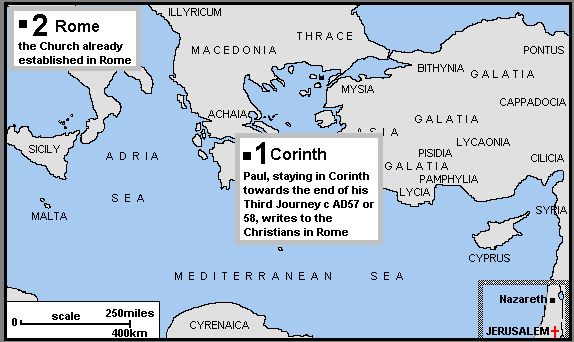
Paul wrote Romans from Corinth in about A.D. 57 (at the time of Acts 20) to the Christians in Rome who were mostly Jewish but also contained many Gentiles. He wrote it to introduce himself to them and to give them a sample of the message he would bring to them on his way to Spain. He had never met them face to face.


Romans is a carefully organized statement of Paul's faith. Many have called it the "Constitution of Faith" because when we understand it, we understand more about the gospel of Jesus Christ. By reading it we will understand the concepts of propitiation, reconciliation, redemption, sanctification, and justification. 


With this "Constitution," Paul was combating the two groups spreading the heresies of the time: 

1) Antinomians ("against law") who believed that since a man was saved by grace, he could live any way he wanted. 
2) Judaizers who believed that man was saved by grace but still under the Law set down in the Old Testament. They added circumcision and works to faith in Christ. 
The theme is the righteousness of God. Some of the keywords in this book are justified (justification, justly, just), righteous (righteousness), grace, faith, Law, wrath, judge (judgment), gospel, believe, sin, and hope. 

Like many of Paul's epistles, the first part is doctrinal (1-11), and the second part is practical (12-16). 


I cannot stress enough how foundational this book is to faith. I think every follower of Jesus should study this book (along with Genesis, the gospel accounts, Ephesians, and James). 


I hope you enjoy it!


BACKGROUND


Romans 1

Paul introduced himself as an apostle who "calls people from among the Gentiles to the obedience (more on that tomorrow) that comes from faith." We know Paul's story from our previous study of the book of Acts.


Oswald Chambers writes this of Paul: 

Our calling is not primarily to be holy men and women, but to be proclaimers of the gospel of God . . . Paul was not conscious of himselfHe was recklessly abandoned, totally surrendered, and separated by God for one purpose to proclaim the gospel of God.
He tells them that this gospel has been promised from long ago, in the Old Testament. If you have been in the Bible Book Club for the last two years (or five if this is your second time through), you know that The Scarlet Thread of Redemption regarding Jesus Christ, a descendant of David, runs throughout the Old Testament. The events of His death, burial, and resurrection were all prophesied in the Old Testament (1 Corinthians 15:1-8). We learned from our study of the gospel accounts how many Old Testament prophecies were fulfilled in the coming of Jesus, the Messiah. 

After this introduction and greeting to the Romans, Paul talks about the righteousness of God and how the gospel reveals God's righteousness and has His power to save all who believe in it.


The last part of this chapter deals with His wrath against the ungodly revealed in the gospel (1:18-32). I will leave it to you to observe how the ungodly are described, how the wrath of God is revealed, and the results of God's wrath. 


We are without excuse even if we live in countries where the gospel is not proclaimed because God promises to reveal Himself if we seek after Him (Jeremiah 29:13) no matter where we are. This is a tough thing for people to grasp.  God is constantly revealing Himself if we are looking for Him. Read more about this in the application. 


One brief word on the "wrath" of God that is mentioned in Romans 1:18. We often want to hear about the love of God, but His love is magnified when we understand His wrath. "Wrath" is the Greek word orge. Greek scholar, Spiros Zodhiates, defines wrath this way:

Utter abhorrence to sin but longing mixed with grief for those who live in it (Heb. 3:11; 4:3; Sept.: Ex. 4:14; 32:11; Deut. 29:20; Is. 10:5). (The Complete Word Study Dictionary: New Testament, #3709)
He is holy and cannot dwell with sin, but He wants the sinner to come to Him, so He does not have to give the wrath that His holiness requires. There will be more on that when we study the word "propitiation" later on in Romans. 

There is so much in this chapter. Study it deeply!


REFLECTION

For I delivered to you as of first importance what I also received, that Christ died for our sins according to the Scriptures, and that He was buried, and that He was raised on the third day according to the Scriptures. (1 Corinthians 15:3-4) 
If you have been with the Bible Book Club, you know that I have a drum to tap: You cannot deeply understand the gospel of Jesus if you do not understand the Old Testament Scarlet Thread of Redemption. So, I hope you can join us in the journey through the Old Testament someday if you have not already done so. 

So, how was Christ's death "according to the Scriptures"? The most vivid example of this is in Exodus 12 where during the Passover, a perfect lamb was slain, and the blood was put on the side posts and crossbeam of the door of entrance to the house so that the wrath of God would "pass over" the homes of the Jews living there so that the firstborn sons would not be killed. Christ is our Passover so that God's wrath could "pass over" us (John 1:29; 1 Corinthians 5:7). We will learn more about that when we study the word "propitiation" later on in Romans. 


Psalm 22 and Isaiah 53 are also "according to the Scriptures" kinds of passages regarding the death of Jesus Christ. 


The resurrection can be compared to Psalm 16:8-11 and Jonah 1:17; 2:10. 


APPLICATION 


Meditate on some of the Old Testament passages mentioned in the reflection above or memorize Romans 1:16-17. This is a key verse in the Bible. 


Regarding God revealing Himself in remote places, I heartily recommend:


Eternity in Their Hearts: Startling Evidence of Belief in One True God in Hundreds of Cultures Throughout the World by Don Richardson. 

It will blow you away!

PRAYER


You make Yourself known to all who seek You. May we seek You with all our hearts and obey when You send us out to proclaim You to the world. Amen.