Wednesday, April 17, 2013

Acts 17 - The Incarnational Gospel

LINK: Acts 17


Maps by Gordon Smith can be used without further permission. http://www.ccel.org/bible/phillips/JBPhillips.htm


BACKGROUND

In Thessalonica (17:1-9)

Paul and Silas left Philippi (12) and went to Thessalonica (15) about 100 miles away. Thessalonica is modern-day Salonika or Thessaloniki. It was the capital of Macedonia and a major port. It was an important center of trade along the Egnatian Highway

They went to the synagogue and concentrated on reaching the Jews for three weeks before they turned to the Gentiles. Some Jews and a large number of Gentiles believed. We learn from 1 Thessalonians 1:9 that the majority of the converts were from the Gentile community.  True to the "Acts Pattern," this led to persecution, but Jason (possibly Paul's relative, Romans 16:21) got the brunt of it. Paul and Silas left there to go to Berea (16), 46 miles southwest of Thessalonica.

In Berea (17:10-15)

Oh, to be a "noble-minded" Berean and to find Berean-like seekers of God who "received the word with great eagerness and examined the Scriptures daily to see if these things were so" (17:11)! The proclamation of the gospel here led many to believe and persecution (from Thessalonica) to follow.  This time, Silas and Timothy stayed behind to strengthen the church, and Paul went on to Athens (17). We know from 1 Thessalonians 3:1-2, 6 and Acts 18:1-5 that they did eventually rejoin Paul in Athens. 

From Macedonia to Achaia: Paul in Athens on Mars Hill (17:16-34)

Athens was in great decline during this time, but it was still a center of culture, philosophy, and education. Idolatry was rampant and new ideas were in vogue.

The Epicureans and Stoics invited Paul to speak to them in the Areopagus (meeting place for the council that oversaw religion and education):
  • Epicureans believed seeking happiness and pleasure was the primary goal of life. 
  • Stoics believed thinking was more important than feeling. They lived in harmony with nature and reason while suppressing the desire for pleasure. 
Paul presented the gospel in a culturally appropriate way. In past examples in Acts, we have seen Peter and Paul reciting Jewish history and reasoning from the Scriptures regarding Jesus, but these people from Athens had no background in the Scriptures. Therefore, Paul started with a case for the one true God using culturally relevant examples (17:22-23). He established what they agreed upon about God. He even quoted from Epimenides, a Cretan poet: 

"For in Him we live and move, and have our being." 

He also quoted Aratus: 

"We are His offspring" 

(Donald Miller reads the poem in the audio version of the sermon below). 

He established culturally relevant common ground, but Paul did not hold back in proclaiming that as God's offspring, they had a choice to believe in the resurrection and repent or face judgment (even though they had no concept of this in their culture). Some did believe in Athens.

Below is a wonderful "take" on this chapter by Donald Miller. 

REFLECTION

The Incarnational Gospel

In October 2006, I visited Imago Dei Church in Portland, Oregon, my book club had read Donald Miller's book, Blue Like Jazz, and decided to take a "field trip" to the church he talked about so much in his book. He was not the pastor, but imagine our surprise and delight when he walked across the stage, and I, having never seen even a picture of him said to my friend, Connie, is that Donald Miller? She said, "Yes!" 

The pastor was sick, and Donald was called in at the last minute to deliver a sermon on Acts 17.  Here is a synopsis of his reflection on Acts 17:16-34:
If we claim to be a Christ follower, then we are following the Prince of Peace. Why is it that when the world is looking for peace, the church is not typically a place they seek advice? Could it be that we really have no clue about what it looks like to be peace-makers? It is not quite that simple though, because our Prince of Peace is also described as bringing a sword. What is that all about? It appears Christ walked a tightrope of tension being a peacemaker and turning over tables. Not very many modern-day examples come to mind. Martin Luther King is perhaps one example of a man, sticking to his convictions of truth, who walked this tightrope well. Most of us fall victim to one or both of two common temptations: judging others or enabling others.
The Apostle Paul is a biblical example of a man who walks the tension between peace and truth-telling in integrity. At Mars Hill, in Acts 17, he brings truth (the whole truth) to the Athenians in a peaceable way. Paul imitated Christ in several ways. First of all, he went to them. He initiated. He pursued. Second, Paul actually cared about them. He liked their culture to some degree (he knew their poetry and customs). The fact that he took time to share the gospel with them indicates that he cared about their spirituality. Third, he didn’t base his approach on pragmatism (what works), but rather on truth. He is not obnoxious about it, but he certainly does not limit what he says about Christ. He says Christ is the only way. Paul does not end up merely judging the Athenians. Nor does he enable them to continue in their pluralistic theology. He walks the tightrope of being a peace-maker and truth-teller. Excerpt originally from: http://www.imagodeicommunity.com/sunday/sermon-archive/incarnational-gospel/ (Imago Dei no longer contains the audio or written version of this sermon.)

Don't we all walk that tightrope of judging others or enabling them, being a peace-maker and truth-teller? 

(Someday, I will post the picture we took with Donald after the sermon. It was phenomenal!)

APPLICATION

Evaluate how you are incarnating the Gospel with the points Donald made about how Paul did it:

He went to them - So much of incarnating the Gospel is going out of our door, and many of us do not. We stay in our little silos of friends, and we don't go out of our own bubble to others. 

He cared for them - We get pretty caught up in our own stuff and don't open our life to loving and caring for those who do not know God. Also, there is so much to knowing and appreciating another's culture that we often do not take the time and effort to do.  

One way my husband and I showed we cared was to learn the language when we lived in Malaysia for two years while he was working for the Forestry Institute of Malaysia (FRIM).  You would be amazed at how many Westerners make no effort to do this!  
After a year of living there, I went to buy a traditional outfit for my husband and was explaining to the man in the store that my husband is very tall so he could probably not fit in anything that he had in his shop on the rack and would have to have it custom-made. The whole time, he stood looking strangely at me with his jaw dropped. I kept speaking faster and faster as I was thinking he was amazed at how tall my husband and I were. 

When he finally regained his speech, he shouted so that the whole shop could hear him, "You are a white woman, and you know my language!" 

He then proceeded to turn to all the local people in the shop saying, "She is a white woman, and she knows our language!" 

He turned back to me and said, "Thank you so much!"

Caring involves entering into another person's world. 
(What is funny is that I didn't even realize my speaking in Malay was the thing that had astonished him.) 

How are you doing in these two areas? Talk to God about this and listen to Him.  


PRAYER

Lord, help us to be messengers of Your peace, proclaiming the Prince of Peace. Amen.

Tuesday, April 16, 2013

Acts 16 - The Macedonian Vision

LINK: Acts 16

Maps by Gordon Smith can be used without further permission. http://www.ccel.org/bible/phillips/JBPhillips.htm

BACKGROUND

Paul's Second Missionary Journey (A.D. 50-52)

Paul stopped in Lystra (5) and wanted to take Timothy with him as he continued on his travels. Timothy was a spiritual "son" to Paul (1 Timothy 1:2).  They continued from town to town delivering the decrees of the Jerusalem Council (15:23-29) and strengthening the churches.

The Spirit of Jesus prevented the mission party from going to Asia Minor and Bithynia, but Paul had a vision telling him to come to Macedonia to help them. Macedonia was a Roman senatorial province and is in modern-day northern Greece. The mission party of Paul, Silas, Timothy, and Luke (author of Acts) left immediately to go and preach the gospel. 

They went to a key city in Macedonia, Philippi (12), in modern-day Kavalla. Philippi was founded by Philip, the father of Alexander the Great. It was a Roman colony and military center. Paul preached the gospel there, and Lydia became the first convert in Europe! The beginnings of the church there caused persecution and imprisonment of Paul and Silas, leading to a miraculous earthquake opening the doors and eventual conversion of the jailer and his entire household (16:31-33).

Trivia: Paul's combined trips by land and sea ended up being the equivalent of 13,000 airline miles! Wow!

Keep Reading! 

PRAYER

Lord, help us to be sensitive to Your Spirit's call. We want to go where You want us to go and to do what You have for us to do. Show us the way. Amen. 

Monday, April 15, 2013

Acts 15 - Solving the "Gentile Problem"

LINK: Acts 15

BACKGROUND


Do the Gentiles have to follow the laws of Moses and Jewish traditions and become Jewish to be saved?  This was the burning question that was on everybody's mind at the council at Jerusalem in about A.D. 49. 


The men mentioned in Acts 15:1 were probably Judaizers. These were devout Jewish Christians who could not give up keeping the Law even after they became followers of Jesus. In the Old Testament, circumcision was commanded (Genesis 17:14, Exodus 12:48-49) and a sign of justification by God. Many commentators believe that the Judaizers were motivated by their desire to maintain control and authority over the Gentiles as the movement grew. 


The issue was formally settled at this council after much discussion (healthy!). When Peter addressed his brothers, he looked back to the conversion of the Gentile, Cornelius, which had occurred about 10 years prior (Acts 10:1-11:18). Peter asserted that salvation by God's grace through faith was the only means of salvation. This was all settled long before Paul and Barnabas began to minister to the Gentiles.


James, Jesus' half-brother and author of the book of James, was evidently the head of the church at Jerusalem and issued a summary statement affirming Peter's statement. Paul will go on to clarify the relationship between Jews and Gentiles in Ephesians 2-3 and Romans 9-11. God will fulfill His covenant with David (2 Samuel 7:25-29) with Jesus, a descendant of David, seated on His throne. But it is through Israel's fall that the Gentiles would find salvation (Romans 11:11-16).


James went on to point out that Amos 9:11-12 agreed with this conclusion. Here is what I wrote previously about Amos 9 in
 the Bible Book Club:
The Scarlet Thread of Redemption 
That promised descendant will be fulfilled by the Messiah, Jesus, who will establish His rule forever. He will rule in the Messianic kingdom and will include both Jews and Gentiles (the "remnant of Edom" in Amos 9:12). He will bring light, justice, and full knowledge of the LORD to all nations on the earth (Isaiah 9:1-7; 11:1-13; 42:1-7; 45:22-25; 49:5-7; 55:1-5). It should be noted that at the Jerusalem Council, James cited Amos 9:11-12 as proof that the Gentiles did not need to be circumcised and live as Jews to be saved (Acts 15:1-20). They would have full rights in God's coming kingdom!
Entrance into God's kingdom was not about a physical circumcision but a circumcision of the heart! 

The resulting judgment, in the form of a letter to the Gentile believers, was that they abstain from three things prevalent among them:

  1. Food sacrificed to idols (they would often give away and sell portions)
  2. Meat of strangled animals and from consuming blood (Leviticus 17:10-14, life is in the blood) 
  3. Sexual immorality that was part of idol worship (Leviticus 18:6-20)
While these were commands from Jewish ceremonial Law, they would also be condemned by Paul in 1 Corinthians 8-10 and by Jesus in Revelation 2:14, 20. It would also promote unity with the Jewish believers if the Gentile believers abstained. 

Acts 15:36 marks the beginning of Paul's second missionary journey and a parting with Barnabas over the question of whether John Mark should accompany them. What a contrast with the unity that was achieved at the Jerusalem Council! 


Barnabas and John Mark were cousins (Colossians 4:10). Barnabas wanted him on the journey even though John Mark had deserted them on the first missionary journey (Acts 13:13). The "sharp disagreement" between Paul and Barnabas resulted in Barnabas taking John Mark to his native Cyprus while Paul took Silas to Syria and Cilicia. Despite their disagreement, the gospel was spread throughout two regions instead of just one! WIN-WIN! We know that Paul eventually came to appreciate John Mark toward the end of his life and found him "useful . . . for service" (2 Timothy 4:11). 


REFLECTION/APPLICATION

Warren Wiersbe writes: 

The progress of the Gospel has often been hindered by people with closed minds who stand in front of open doors and block the way for others. 

In 1786, when William Carey laid the burden of world missions before a ministerial meeting in Northampton, England, the eminent Dr. Ryland said to him, “Young man, sit down! When God pleases to convert the heathen, He will do it without your aid or mine!” More than one Spirit-filled servant of God has had to enter open doors of opportunity without the support of churches and religious leaders.
Paul would have agreed enthusiastically with the words of Robertson McQuilken from his book The Great Omission: “In a world in which nine out of every ten people are lost, three out of four have never heard the way out, and one of every two cannot hear, the church sleeps on. Could it be we think there must be some other way? Or perhaps we don’t really care that much.” Paul cared—and so should we. (The Bible Exposition Commentary, Ac 14:21; 15:19)
Do you care about the "heathen"?  

Do you see how you fit into God's plan for reaching the unreached of the world?
How much does your culturally-biased understanding of following Christ inhibit your ability to see people from other cultures following Jesus in ways culturally appropriate for them? 

Note: This post has taken me WEEKS to write. I am not sure why. I always appreciate prayer for a breakthrough when I have these blocks! I have set aside the next two weeks for writing and praying. Please pray for me. :)


PRAYER


Lord, who are the "Gentiles" among us? Help us to care about them and open our eyes to see that the fields around us are "white for harvest" (John 4:35). We ask this in Jesus' name. Amen. 

Sunday, April 14, 2013

Acts 14 - Paul's First Missionary Journey: Part II

LINK: Acts 14 

Paul's First Missionary Journey, with Barnabas to Cyprus and Asia Minor c AD46-48
and Its Sequel, the Council at Jerusalem c AD49 from 
 http://www.ccel.org/bible/phillips/JBPhillips.htm

BACKGROUND

Iconium (14:1-6)


Even though Iconium (7) was in Lycaonia, the citizens were primarily Phrygian in language and culture.  Paul and company follow the familiar pattern of going to the synagogue, preaching boldly, and having Jews and Gentiles believe but having some Jews oppose. Signs and wonders validate Paul's ministry (Galatians 3:5). Then, they flee to Lystra and Derbe.


Lystra (14:7-20)


Paul and Barnabas "continued to preach the gospel" in Lystra (8). The historical background behind the healing of the lame man and the subsequent desire of the people of the city to worship Paul and Barnabas is interesting:

Zeus and Hermes (also known as Jupiter and Mercury) were two popular gods in the Roman world. People from Lystra claimed that these gods had once visited their city. According to legend, no one offered them hospitality except an old couple, so Zeus and Hermes killed the rest of the people and rewarded the old couple. When the citizens of Lystra saw the miracles of Paul and Barnabas, they assumed that the gods were revisiting them. Remembering the story of what had happened to the previous citizens, they immediately honored Paul and Barnabas and showered them with gifts.  (The Life Application Bible, Acts 14:11, 12, p. 1983)
God gave Paul and Barnabas the ability to humbly respond to these Gentiles, showing them that God had not left them without witness through His creation (Psalm 146:6; Romans 1:19f). 

Jews came in from Antioch and Iconium (like Al-Qaeda has infiltrated peaceful countries to stir up trouble), and stirred up the once-welcoming crowd so that they stoned him and left him for dead! How fickle the people were!


Derbe (14:20-21)

Even after stoning, Paul and Barnabas went to Derbe (9), preached the gospel, and made disciples. 


Return to Antioch of Syria (14:21-28)

After Derbe, they backtracked through Lystra (10), Iconium (11), and Pisidian Antioch (12). No doubt they were risking their lives by doing so, but they believed that the follow-up of the new believers there was really important.  They taught by word and deed that hardship was part of entering the kingdom of God. (I will have a LOT to say about both follow-up of new believers and developing a "theology of suffering" for your life later on in the New Testament.)  After strengthening the disciples, they prayed and fasted and appointed elders for the church there, committing them to the Lord.

After this, they preached the word in Perga (13) and Attalia (14) before returning to Antioch where they gave a full report to the church there. 


It is believed that Paul wrote his letter to the Galatians while he was staying in Antioch (A.D 48 or 49). 
(Feel free to read it now if you prefer to read the New Testament in chronological order.)  It is believed that Iconium, Lystra, and Derbe were part of the Galatian region for which the letter was intended. The reason it is believed to be during this time is that in the letter to the Galatians, the question of whether Gentiles should be required to follow the Jewish Law was not resolved. This will be resolved in Acts 15. Stay tuned!

REFLECTION 

I just returned from a 48-hour prayer summit with the leaders of the valley in which I live. Eighty men and forty-four women gathered for praise, repentance, and prayer for each other and our valley. The last session involved many confessions for our lack of confidence in sharing the Good News of Jesus with the lost around us. Why can't we be bolder, risking persecution, like Paul and Barnabas? 


Many were so busy with all their church programs that it left no time to develop relationships with non-believers, another was laziness about meeting neighbors, another was a lack of compassion for the lost, another was fear of rejection, another was lack of confidence.

What is it for you?

APPLICATION 


On a scale of 1 - 10 with 1 being no confidence and 10 being very confident, where are you on your confidence in sharing the Good News?  Is it a lack of skill or a lack of confidence?


Spend some time with God and ask Him what is keeping you from boldly sharing the Good News. What would He have you do to grow in that area of your life? 


I am a firm believer that we spill over from that which is filling our hearts, and our hearts of love and compassion, and service spill out into a lost world. So, what are you filling your heart with these days?

Sharing your faith is part of being a balanced disciple of Christ. I love to take people on a journey from Creation to Christ where we discover the Scriptures together. You do not have to have all the answers! Here is
a downloadable handout I created that has all four discovery studies and a guide for leading them:

Discovery Study with Lists

Since I wrote this post in 2010, there is also a great Discovery Study App that has multiple languages. 

PRAYER

Lord, make us bold in sharing the Good News! Amen. 

Saturday, April 13, 2013

Acts 13 - Paul's First Missionary Journey: Part I

LINK: Acts 13

BACKGROUND


Paul's First Missionary Journey, with Barnabas to Cyprus and Asia Minor c AD46-48
and Its Sequel, the Council at Jerusalem c AD49 from 
 http://www.ccel.org/bible/phillips/JBPhillips.htm

While Peter was the central figure in Acts 1-12, Saul takes that place as the gospel focuses on ministry to the Gentiles in Acts 13:1-28:31. The numbers in parentheses refer to points on the map! I like to listen to the audio in the link above and track their journey on the map. 

Syrian Antioch (13:1-3)


Jerusalem was the "mother" church, but Syrian Antioch (1) was the missionary church on the Orontes River. Its leaders were Barnabas from Cyprus (4:35); Simeon, who is believed to have been from Africa because his nickname means "Black"; Lucius from Cyrene in what is the western part of modern-day Libya, men from both Cyprus and Cyrene were the people who first preached the Gospel in Antioch (11:20); Manaen, who was a friend of Herod Antipas, who killed John the Baptist; and Saul (Paul).


These men are described as "prophets and teachers." Prophets are those who lay the foundation for the church and teachers help establish the new believers in the faith (11:20; 27-30; Ephesians 2:20; 1 Corinthians 14:29-32; 2 Timothy 2:2). Here are two separate Bible Studies exploring the gifts of Prophecy and Teaching. Here is a guide for doing a Greek Word Study too!


After fasting and praying, the elders of the church in Antioch set apart ("dedicated for a special purpose") Barnabas and Paul. After the elders placed their hands on them, they were sent out for what God had already called Paul to do (Acts 9:15) on their first missionary journey to the Gentiles (Acts 21:17-21). 

John Mark, cousin of Barnabas and son of Mary, who often hosted gatherings in her home in Jerusalem (Colossians 4:10; Acts 12:12), went with (Saul) Paul and Barnabas to assist them. 

Cyprus (13:4-12)


Passing from Seleucia (2) to Salamis on the island of Cyprus (3), they preached the Word of God in the Jewish synagogues before they arrived at Paphos (4). Cyprus was the home of Barnabas (4:36). It was common in that day for high Roman officials like Sergius Paulus to have a private sorcerer like Bar-Jesus (This means "son of Jesus [Joshua]." His nickname, Elymas, means "sorcerer".).  Of course, this false prophet would do anything to oppose Barnabas and Paul (Acts 13:9 is the first reference to Saul as Paul). Paul told Bar-Jesus that his name was not "son of Jesus" but "son of the devil" and blinded him. This is the first recorded miracle God performed through Paul. With this display of God's power, the Roman official believed. Notice that this is a conflict with a Jew (Bar-Jesus) over preaching the gospel to a Gentile (Roman official). This is the first of many times when Jews would try to frustrate the progress of the gospel. It is also the second out of four reported incidents of a "power encounter" with demonic influences in Acts. The other incidents are in Acts 8:9-23; 16:16-18; and 19:13-17.  


Pisidian Antioch (13:13-52)


Paul and company sailed to Perga (5), but John Mark deserted Paul and his companions and went back to Jerusalem, and we do not know why. We do know from reading later on in Acts 15:38 that Paul was not pleased with his defection. Stay tuned for more on that subject. 


Pisidian Antioch was in Phrygia (6). Paul preached in the synagogue from the Old Testament Law (the first five books called the "Pentateuch") and Prophets. This means the entire Old Testament (Matthew 5:17; 7:12; 11:13; 22:40; Luke 16:16; Acts 24:14; 28:23; Romans 3:21). 


In Paul's message of exhortation following the Old Testament readings, Paul started with the covenant God had made with His chosen people. Then, Paul presented that Jesus was the fulfillment of Old Testament prophecies (13:16-25). Following this, he went on to explain that the rejection, crucifixion, and resurrection of Jesus were also part of what God had foretold long ago (13:26-37). Finally, he appealed to them to believe in Jesus, be forgiven, and be justified; something the Law could never do (13:38-41).


While many wanted to follow Jesus, the Jewish leaders were jealous of Paul and Barnabas and spoke abusively against them. Paul and Barnabas boldly proclaimed that, while they were obligated to speak the word of God to the Jews first (Matthew 23:39; Romans 11:26), the Jews had rejected it. Therefore, they would go to the Gentiles (13:46). Jesus was the Jewish "light to the Gentiles," and Paul and Barnabas would be His messengers (Luke 2:32; Isaiah 40:6)! This filled the Gentiles with gladness (13:48).


The word of God spread, but it incited persecution in the region. Paul and Barnabas were expelled, so they shook the dust from their feet as Jesus had instructed them to do (Matthew 10:14) and went to Iconium (7) with joy in the Holy Spirit (13:52).


REFLECTION 
That sainted missionary to India and Persia, Henry Martyn, once said, “The Spirit of Christ is the spirit of missions, and the nearer we get to Him, the more intensely missionary we must become.” (The Bible Exposition Commentary, Acts 13:1)
I used to have people say, "Well, missions is just your thing. I am into such and such."  I propose to you that missions is everyone's thing if we are walking in nearness to Him. It does not mean that we will get on a plane tomorrow, but it does mean that we will somehow be involved in God's global cause. Sharing Christ locally is very important, but Paul and Barnabas were "sent out" to regions beyond to the "ends of the earth" where the gospel had not yet been proclaimed according to Jesus' direction in Acts 1:8.

God's heart is that the gospel of the Kingdom is preached in the whole world (Matthew 24:14). Out of the 16,500 unique people groups in the world, 6900 are considered unreached. Yet the vast majority of funds (90%) and people-power go to the most reached places on the earth! I think this is so sad!  

APPLICATION 

What is your next step in getting involved in God's global cause? 


Here are some suggestions:

  1. Take Perspectives on the World Christian Movement in your area. 
  2. Start praying for the unreached people of the day here or you can download an app.
  3. Invite a global worker to dinner and ask how you might pray for them!
PRAYER

Lord, give us a heart like Paul and Barnabas who took the gospel to the ends of the earth. Amen. 

Friday, April 12, 2013

Acts 12 - Angels Watching Over Me

LINK: Acts 12

FYI: We are 90% of the way through and on the final 10% stretch of the Bible! WOOHOO!

BACKGROUND

Getting a Grip on Agrippa I


He was the grandson of Herod the Great, the ruler who killed the innocent boys two years old and younger because he was looking for Jesus (Matthew 2:1-18). He was appointed by the Roman emperor, Caligula, as governor of all of Palestine. He was a persecutor of the early believers because he wanted to be in favor with the Jews. He imprisoned Peter and had James put to death by the sword.  He died in A.D. 44 in Caesarea because he did not glorify God (12:23 and the Antiquities of the Jews 19.8.2 by Josephus). He was succeeded by Felix and Festus. Three of Herod's children will be mentioned later on in Acts: Drusilla, wife of Felix (24:24-26), Bernice (25:13, 23), and Herod Agrippa II (25:13-26:32) who ruled from A.D. 50-70. 

Which James was Slain?

The James that was slain was a son of Zebedee and Salome. He was also called one of the "sons of Thunder" because of his boldness. He was the elder brother of John and one of the twelve disciples. He was also called "James the Greater." He was a fisherman and in partnership with Peter (Matthew 20:20; 27:56). He was one of the inner core of three among the twelve who were present at the transfiguration along with Peter and John (Matthew 17:1), the raising of Jairus' daughter (Mark 5:37-43), and in the garden (14:33).  He was slain in fulfillment of the prophecy by Jesus in Mark 10:39. 

The other people named James in the New Testament are: 
  • the son of Alphaeus (Mark 3:18)
  • the father of Judas (not Iscariot; Luke 6:16)
  • the half-brother of the Lord (Gal. 1:19) and believed to be the author of the Epistle of James.
REFLECTION 

I could not resist posting this Amy Grant 80s music video to a song based on Acts 12 called "Angels Watching Over Me." The video quality is poor, but it is a fun blast from the past:


APPLICATION

But on a more serious note, please pray for those in prison for their faith. The Voice of the Martyrs website has a "Prison Alert" that has excellent fuel for prayer. 


PRAYER


Give us the courage to pray bold and faith-filled prayers for our brothers and sisters who are imprisoned for their faith throughout the world. Give them strength and courage and bold witness for You. We pray this in Jesus' name. Amen. 

Thursday, April 11, 2013

Acts 11 - Who Was I that I Could Stand in God's Way?

Maps by Gordon Smith can be used without further permission. http://www.ccel.org/bible/phillips/JBPhillips.htm
LINK: Acts 11

BACKGROUND

Peter's Defense to Jews in Jerusalem (11:1-18)

This chapter is a recounting by Peter of the events of Acts 10 to the Jerusalem believers who questioned, not that Peter had preached to uncircumcised Gentiles, but that he had eaten with them. Many believers still held to the Law of Moses (15:5; 21:20; Galatians 2:12). Some Jewish believers wanted Gentiles to become like Jews (become circumcised, follow the Law) and some Gentiles wanted Jews to become like Gentiles. This "dividing wall" needed to break down if Jew and Gentile believers were to come together as "one body" (Ephesians 2:11-3:12).

I love Peter's bottom-line response after his story:

"Who was I that I could stand in God's way?"

Peter simply obeyed God's vision and revealed that their argument was with God and not with him. Peter's story silenced them and caused them to glorify God that the Gentiles were included in "repentance that leads to life" (11:18)!

Side Note: Most scholars believe that the Book of James was written during the period between verses 18 and 19. We will study that later in the year or you could stop your reading in Acts and read it right now if you prefer going through all the epistles in (possible) historical order. Other scholars believe it was written in A.D. 62 after the prison epistles (Ephesians, Philippians, and Colossians) and the time of the events in Acts in A.D. 62.

Antioch Church (11:19-30)

Here is a very significant turn in the book of Acts: the church began to preach the Lord Jesus to Gentiles (uncircumcised Greeks). Before that, there had been a few instances of Gentiles seeking them out (Ethiopian eunuch and Cornelius) for salvation, but it was never the other way around. 

As a result of the martyrdom of Stephen (7:60), a great persecution arose in the church in Jerusalem causing the believers to be scattered (8:1) to Phoenicia, Cyprus (#1 on the map), and Syrian Antioch (#3). 

Antioch (present-day Antakya, Southern Turkey) was the third largest city in the Roman Empire after Rome and Alexandria, Egypt. It was a commercial center because it was at the junction of the trade routes between East and West. There was widespread immorality and ritual prostitution that was part of temple worship. 

The believers from Cyprus and Cyrene preached the Lord Jesus to the Greeks and a large number "turned to the Lord" (11:21). This caused the church in Jerusalem to send Barnabas to check it out. 

Barnabas was from Cyprus (4:36; 11:20). He was generous (4:37), an encourager (11:23, 4:36), good, full of the Holy Spirit, and of faith (11:24). He rejoiced in the new church in Antioch. He brought Saul there; and, together, they discipled the new believers. They were called "Christians" which means "belonging to the party of Christ." This term is used two other times in the New Testament (26:28; 1 Peter 4:16).  The church was becoming more and more disconnected from Judaism.


Finally, the primarily Gentile church in Antioch sent relief, via Barnabas and Saul, to the primarily Jewish church in famine-stricken Judea. This is documented by the Jewish historian, Josephus.  This fulfilled the principle found in Galatians 6:6, "The one who is taught the word is to share all good things with the one who teaches him."

REFLECTION 2023

Since I wrote this in 2010, I went to Salami, Cyprus (#1 on the map) where Barnabus was born, and Paul went there on his first missionary journey! It was so exciting to walk where Paul and Barnabas walked!

We were there for a prayer conference in 2022, and one of the things we did was pray for the people who live there now. 

APPLICATION

What is your "I will" statement for today? What is this passage leading you to do? Who will you tell what you learned? Who will hold you accountable to follow through on these two things? It is so good to have other believers who hold you accountable to obey what you have learned.


PRAYER

Lord, thank You that Your Word spread from Judea to Samaria and the uttermost parts of the earth (Acts 1:8). Teach us how we can be part of Your plan! Amen. 


Wednesday, April 10, 2013

Acts 10 - Peter and Cornelius

LINK: Acts 10 


Drawing by Michael Weaver
BACKGROUND

Session 5: Preaching the Good News from the Acts of the Apostles Retreat is based on Acts 10:34-48

To understand why Peter refused God's offer to eat unclean food three times, it is very important to read the post for Leviticus 11 from YEAR ONE of the Bible Book Club in the Reflection section below. 

The events in this chapter were so significant that Peter told it three times (Acts 10, 11, and 15:6-9). So, this is a significant event in Scripture. Learn it well!

Cornelius was a Roman officer in charge of 100 soldiers in the Italian Regiment which consisted of 600 soldiers. He was not a full Jew, but he feared God. Jeremiah 29:13 says "You will seek Me and find Me when you search for Me with all your heart." Cornelius was what we would call today a "seeker" and "sharer"; a true "person of peace." (See the Reflection section in the post for Luke 10 for a more detailed explanation about a "person of peace.") 

Our sovereign God coordinated the visions of Cornelius and Peter so that this Gentile and his entire household would find a relationship with God through Christ when Peter solemnly testified that Jesus is "the One who has been appointed by God as Judge of the living and the dead" (10:42). What a surprise for observing Jews that the gift of the Holy Spirit was poured out for Gentiles as well (10:45), but that had been God's plan all along. We will see more of this as we study the book of Romans. 

REFLECTION

As I have said from the beginning of the Bible Book Club, Gentiles were always part of God's plan for salvation, and He certainly led the way for it in this case! God "accepts men from every nation (people) who fear Him" (10:35). 

For review, here is what I wrote regarding Leviticus 11
As I was meditating on Leviticus 11, my son was meditating on Acts 10 by illustrating the picture above. In Acts 10, Peter saw a sheet descending from heaven with all kinds of those forbidden animals mentioned in Leviticus 11. A voice told him to "arise, kill, and eat!" Of course, Peter said he could not because those animals were unclean! A voice said, "What God has cleansed, no longer consider unholy." Wow! What a radical shift! 
The gist of what God was trying to tell Peter was what Jesus already said in Mark 7:14-23 and Matt. 15:10-20: that nothing outside the man was going to make him "unclean" but a person is defiled morally by what he thinks in his heart. He was getting at the hypocrisy of the "cleanness" of the Jews on the outside when their hearts were hard on the inside. 
Through this vision, God was showing Peter that he "should not call any man impure or unclean . . . and that God does not show favoritism but accepts men from every nation who fear Him and do what is right" (Acts 10:28, 34-35). Before this, Peter would not have even eaten with Gentiles without risking defilement. God enlightened Peter at the proper time so that he could go to the God-fearing Gentile, Cornelius. As a result, Peter would share the good news of Jesus Christ with Cornelius and his family, and they would become the first Gentiles to follow Jesus! 
While God wanted to "set apart" Israel for Himself and to separate them from the pagan practices around them during the time of Leviticus, He still desired that all nations would worship Him, and He still does to this day!
A side note: I love how God orchestrated it for Michael and me to be meditating on related passages on the same day. That is such a God thing! I am also amazed that every single animal he drew on that sheet really was an unclean animal even though he has yet to read the specific unclean animals of Leviticus 11!
APPLICATION

There is a fine balance between being holy and "set apart" from the world and reaching out to the world Jesus came to save. I have often found in my effort to reach out to non-believing friends, I have stepped over too far into the worldly "unclean" side of life where I had to reevaluate and adjust. 

I have also found the other extreme in friends who shelter themselves so much from the world that they have no meaningful impact on the people around them.

Where are you on the continuum?

Maybe you are on one end where there are areas in which you need to consecrate to the Lord and separate from the world's ways so that the non-believers in your life can see that you are different in a very good way.

Maybe you are on the other end where you are so afraid of defilement from the world that you never rub shoulders with those who need Jesus.

How can you come to find a balance between those two extremes? Talk to God about it.

There are good things to ponder from the meditation linked above:
As you listen to Peter preaching in the house of Cornelius, ask yourself how, and with whom you share the Gospel. 
For a moment, try and imagine how the apostles would have felt as they made their journey out into the wider world.
This reading comes with a very clear message – God does not show partiality in preaching the Gospel. The Good News does not belong to one group over another but is something that has to be preached to all. What partiality can you see in your own life in how you preach the Good News?
Speak to the Lord about what that call to missionary discipleship means for you in your own life. 
PRAYER

Lord, help us to be so in tune with You that we hear You and obey You when You tell us to go and do something. Lead us to our "Cornelius" who is a seeker and sharer of You. Give us the boldness to solemnly testify of Jesus Christ. In whose name we pray, Amen. 

Tuesday, April 9, 2013

Acts 9 - The Road to Damascus

LINK: Acts 9

The Life and Epistles of Paul by Thomas Lewin, 1890

BACKGROUND

Session 4: Conversion from the Acts of the Apostles Retreat is based on Acts 9:1-9, 17-19

I love this chapter! The top persecutor of the church, Saul of Tarsus, is blinded by a light from heaven on the road to Damascus while on his way to persecute more believers of that Jewish cult they were calling the "Way" (Acts 9:2; 19:9, 23; 22:4; 24:14, 22).  He is confronted by the question, "Why do you persecute Me?"  Saul was not just persecuting individual followers but persecuting Christ because the church is Christ's body. 

Saul's question, "Who are you, Lord?" reveals to him that he is talking to Jesus.  He is blinded and directed to go to Damascus where Ananias, on the street called Straight, laid hands on Saul. He regained his sight, was filled with the Holy Spirit, and was baptized. 

Maps by Gordon Smith can be used without further permission
(http://www.ccel.org/bible/phillips/JBPhillips.htm)

Acts 9:13 marks the first time that believers are called saints ("set-apart ones"). See also Romans 1:1; Ephesians 1:1; Philippians 1:1. You might want to make a note of that in your Bible.

God's mission for Paul was told to Ananias: 
He is a chosen instrument of Mine, to bear My name before the Gentiles and kings and the sons of Israel; for I will show him how much he must suffer for My name’s sake. (9:15-16)
Saul went to Damascus to persecute the church and ended up proclaiming Jesus as the Son of God (this is the only time this phrase is used in Acts)! No wonder the Jews were baffled ("confounded, bewildered, confused"). Now the persecutor would become persecuted, even having to leave Damascus in a basket.

The Acts account does not reveal what happened between verses 22 and 23, but Galatians 1:17 tells us that he did not "consult flesh and blood" or "go up to Jerusalem" concerning his newfound faith but went to Arabia for three years (Galatians 1:18). Since Arabia was very sparsely populated, it is thought he went there to be away from men and alone with the Lord to consult Him regarding his faith and future mission rather than going to evangelize.

After Arabia, Saul went to Jerusalem. It took the help of Barnabas to convince the disciple that he was a legitimate disciple. After more bold preaching leading to persecution, he went to Caesarea and Tarsus. Tarsus was his hometown. It was a Greek-speaking, Roman province and center of learning. It also linked Syrian Antioch and the rest of the Middle East with the provinces of Galatia and Asia to the west.

In this chapter we continue to see the familiar pattern of Acts:
  • Power of God displayed (light on the road, healing of Saul's eyes)
  • Proclamation of Jesus as the Christ
  • Persecution
  • Propagation of the church (9:31)
Peter's Preparation for Worldwide Ministry (9:32-40)


Israel's airport is just north of Lydda today.

In Acts 8:25, Peter was traveling from Samaria to Jerusalem with John. While in Lydda, he healed Aeneas. This led to many believing. 

In Joppa, Tabitha was raised from the dead. This is the first time in the Book of Acts that this occurred. Again, this led to many believing. Surprisingly, this time there is no record of persecution.

This section is significant because God performed two miracles through Peter in a partially Gentile region. It is also significant to note that Peter stayed with a tanner named Simon. Tanners were considered ceremonially unclean because of their contact with dead animal skins (Leviticus 11:40). This is a perfect segue into Acts 10. 
 
REFLECTION

Ponder the questions from the Acts of the Apostle Retreat for this passage:
Where in your life do you need to follow the example of Saul?
What ways of life do you need to give up in order to become more fully who God wants you to be? It might not be anything as radical as the life of Saul, but Saul’s repentance has some physical sign – the scales fell from his eyes.

Do you need to see anew, or do you have a sense of needing another form of healing?
APPLICATION/PRAYER
Paul speaks directly with Christ in this passage.
In the last few moments of this prayer, can you speak with Jesus as directly as Paul? If you can, ask Him for whatever healing you need. If you can’t speak directly like Paul perhaps you could ask for the grace to be able to do so.
Lord, reveal Yourself to us today. Shed light on where You would have us go and what You would have us do and say. Empower us by Your Holy Spirit. We ask this so the name of Jesus can be proclaimed throughout the whole earth. Amen. 

The first 10 days of the 30-Day Prayer Guide for ISIS is based out of Acts 9. Another great way to apply this chapter is to pray through it. When I wrote this original post in 2010, they were a major threat. While downgraded as a threat, they are still active. Read this article for more information:

Monday, April 8, 2013

Acts 8 - Saul, Philip, Simon, and the Ethiopian Seeker

LINK: Acts 8

BACKGROUND


This chapter is easy to follow so I will touch briefly on the four men in the narrative.


Saul the Persecutor (8:1-3)


Saul is introduced in Acts 7, but we learn more about him in Acts 8 where he is the center of the persecution. With Stephen's martyrdom, the persecution of the church goes into full swing with the followers of Jesus being scattered.  This was in God's plan to send them to Judea, Samaria, and the uttermost parts of the earth (Acts 1:8; 11:19ff). Persecution scatters the church like wind scatters seed, and both produce a greater harvest!  


Many commentators believe that the primary scattering was among the Greek-speaking Jews because they were the focus of persecution due to Stephen being a Greek believer also (Acts 6:3-8:2). It is believed that the native Jews stayed in Jerusalem.  


Philip the Evangelist (8:4-8)


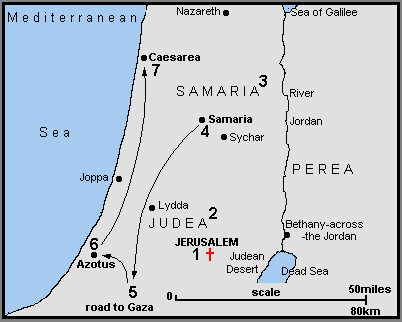
Philip's journey was from locations 4-7. Map supplied by Gordon Smith  http://www.ccel.org/bible/phillips/JBPhillips.htm

Philip, also a Greek-speaking Jew, was part of that scattered seed. He was mentioned after Stephen in the list of seven men appointed to serve the Greek-speaking Jewish widows (Acts 6:5). He escaped persecution in Jerusalem by fleeing to Samaria. Samaritans were "half-breed" people. They were descendants of the Jews who had remained in the land after the Assyrians captured the ten northern tribes in 732 B.C. and intermarried with the imported Gentile people. They had their own temple and priesthood separate from Jerusalem (Acts 4:9). As a result of Philip's preaching and miracles that demonstrated God's power, the Samaritan people believed and were filled with joy (Acts 8:8, 12). Philip was the first missionary!

Simon the Sorcerer (8:9-25)


He was called the "Great Power of God" and astounded the people with his Satan-energized sorcery (2 Thessalonians 2:1-12). The text says that he believed (8:13), but he believed in the miracles that Philip performed without any repentance for his sins. He wanted to pay for the power that Philip had without embracing the Person behind Philip's power. There is a pattern in Acts that shows the conflict between the ministry of the Gospel and money/business (Acts 5:1-11; 16:16-24; 19:23-41). I think many modern-day Christian ministries could learn a lot from this pattern! (See my REFLECTION on Ezekiel 34-35.) 


The Samaritans did not receive the Holy Spirit, and Peter and John came down to lay hands on them to impart it. This was not typical, but some commentators believe it was to unite the Samaritan believers with the Jewish church in Jerusalem since there had been so much division in the past. As he opened the door to Jews at Pentecost, Peter also opened the door to the Samaritans. Stay tuned for the exciting way God used Peter to open the door to the Gentiles (Acts 10)!


The Ethiopian Seeker (8:26-40)


Oh, I love people like the Ethiopian eunuch who seek God and people like Philip who listen to God and obey His call to GO to seekers! What a privilege we all have to tell people the Good News!


This eunuch was not from modern-day Ethiopia but from ancient Nubia, south of the modern-day border of Egypt. He was not allowed to become a full Jewish proselyte because he was a eunuch (Deuteronomy 23:1). A eunuch is "a castrated man placed in charge of a harem or employed as a chamberlain in a palace" (Merriam-Webster Collegiate Dictionary, Tenth Edition). He was allowed to seek God though, and he traveled to Jerusalem from Nubia, over 200 miles, to do so! Phillip encountered the eunuch on his way back to Nubia (#5 on the map).


The eunuch was a man of "good soil" (Luke 8:8, 15). It was the custom to read Scripture out loud (not a bad idea for all of us), and Philip seized on this opportunity to explain Isaiah 53 to him. If you have been with the Bible Book Club, you know that Isaiah 53 is a prophecy about Jesus, the Suffering Servant, and a key chapter in the Scarlet Thread of Redemption (Isn't it fun when everything comes together like this?)! It tells of His birth (Isaiah 53:1-2), life and ministry (Isaiah 53:3), substitutionary death (Isaiah 53:4-9; 1 Peter 2:24; Matthew 26:62-53; Matthew 27:57-60), and resurrection (Isaiah 53:10-12; Luke 23:34,37). The man was so prepared; the eunuch believed and was immediately baptized. 


After this, Phillip was "snatched" by the Spirit and ended up at Azotus (#6 on the map) and eventually Caesarea (#7). 


REFLECTION

I love how Phillip listened to God and obeyed. That is what "evangelism" is all about. We can trust God to lead us to people. When you get to Acts 18, you will hear my story about Sherry and the "manicure/pedicure for Jesus" (God is SO fun!). If you cannot wait, you can read it HERE


Sherry is a great story, but there is also the story of Joanna. I met her at the park while having a picnic with our friends visiting from India. God told me to talk to her, and it turned out that she lived a couple of blocks away from my house. We met at my house a few days after meeting at the park. When we sat down in my backyard as the kids played, out of the blue, she said, "I have always wanted to study the Bible. Do you think you can study it with me?"


This led to a summer study called Foundations for Faith (written by my mentors) with her and another woman.  Joanna came to believe at the end of the study! She was a woman of "good soil."

2023 Update: The authors of the study above, and my long-term mentors went to be with Jesus (Ginny in 2013 and Lorraine in 2019). Their legacy lives on in my heart and in this fabulous study.

APPLICATION


As you go about your day, listen to God to lead you to an Ethiopian in your midst. 


PRAYER


Lord, I would like to ask that You would give each person reading at the Bible Book Club a person of good soil like Joanna and the Ethiopian eunuch! Amen. 

Saturday, April 6, 2013

Acts 6 & 7 - Stephen's History Lesson

LINK: Acts 6 & 7 (Read over two days)

BACKGROUND

Session 3: Discernment from the Acts of the Apostles Retreat is based on Acts 6:1-6

In Acts 6, Greek-speaking Jews who had become followers of Jesus (probably at Pentecost) complained that the native Jewish Christians, who spoke Aramaic which is a Semitic language, were being favored over them in the treatment of their widows. It was probably not due to favoritism but the language barrier. 


Like every church, the early church had its problems, but "the Twelve" - the 11 original disciples plus Matthias (Acts 1:26) - handled it beautifully. They knew their gifting was not in the serving area and delegated it to people that had those kinds of gifts. This is the body of Christ in action, with each person functioning according to their gifts (1 Corinthians 12). An essential part of leadership is learning to delegate when things are out of your gifting. The ministry of the Word sometimes CAN get neglected and bogged down because of administration. It is important to seek out godly, gifted people for these important roles. As a result of the delegation of duties, the Word of God spread and even priests became obedient to it (6:7). 


The leader of this band of servants was Stephen, a man full of God's grace and power, faith, and the Holy Spirit (1:5, 8). He is seized by the opposition, and his speech to the Sanhedrin is a Scarlet Thread of Redemption history lesson from Abraham to Jesus! Despite Israel's constant rebellion, God had a plan and purpose. The original charge against Stephen was speaking blasphemy against Moses and that Jesus would destroy the temple and their customs. This is partially true, but Moses prophesied about Jesus (7:37; Deuteronomy 18:15). Jesus did not come to abolish the Law but to fulfill it (Matthew 5:17). The Jews refused Moses' message, and they refused Jesus' also. Jesus said the Jews had done that throughout their history (Luke 20:9-19). They even killed both those prophets who predicted the coming of Jesus and Jesus Himself (7:52). They had received the Law but had not obeyed it (7:53). 


Stephen was stoned as a result of the speech, but Saul was watching. Stay tuned!


REFLECTION


Last Thursday, our Kingdom Community looked at Luke 24 and Jesus on the road to Emmaus with two of His sad and downcast followers who were trying to make sense of Jesus' death and the disappearance of His body. Along came Jesus saying:

"O foolish ones [sluggish in mind, dull of perception] and slow of heart to believe (adhere to and trust in and rely on) everything that the prophets have spoken! Was it not necessary and essentially fitting that the Christ (the Messiah) should suffer all these things before entering into His glory (His majesty and splendor)?" Then beginning with Moses and [throughout] all the Prophets, He went on explaining and interpreting to them in all the Scriptures the things concerning and referring to Himself. (Luke 24:25–27, AMP)  
Later, Jesus thoroughly opened up their minds to understand the Scriptures. This resulted in a worldwide impact.

On a surface level, it may seem that when Stephen employed Jesus' method of sharing from the whole of Scripture, it was a failure; but one important person was listening. It would take another encounter with Jesus along another road before Stephen's history lesson would bear fruit and lead to a worldwide impact. Stay tuned for Acts 9. 


The overwhelming conclusion from our Kingdom Community last Thursday was that it is important to share Jesus from Creation to Christ regardless of the immediate reaction. Many of them admitted that even though they were raised in the church and knew most of the Bible stories, they did not understand the Old Testament enough to explain how it reveals Christ in The Scarlet Thread of Redemption. Many of them resolved to learn. 


APPLICATION 


You are in the Bible Book Club because you want to rectify this situation. GOOD FOR YOU! I believe part of growth involves time spent in God's presence in His life-giving Word. 

How can you grow more? What is a good next step for you as we are finishing the Bible Book Club this year? If you did not start at the beginning, maybe you can be intentional about doing it in the future. 


Going through the Bible Book Club is a big commitment to do with someone else, but a baby step might be doing a beginning Scarlet Thread of Redemption study. Here are the resources:

Discovery Bible Study App 

Discovery Bible Study with Lists - this has lists for four studies

You can also enrich these studies by doing Imaginative Contemplation and/or Lectio Divina with many of these passages.

Studying is not just about insight about God but encounter with God.

Discovery Studies are APPLICATION-oriented, and you know how much I love that! It is important to create time to listen to God's voice about how He wants you to respond to the passages being studied. I also like the last question, "Who will you tell about what you have just learned?" because even the latest brain science says that sharing what you are processing with another person helps you and the person you are telling. 

The point is that Jesus modeled this type of sharing. Gone are the days of just sharing part of the story. This takes a little more effort, but it is a way to disciple people into the kingdom, making disciples rather than just having people who have made decisions. It is having an effect all over the world! Read Miraculous Movements by Jerry Trousdale. (I just met him this last weekend!) 

I know I have shown this before in the Bible Book Club, but I love how this kind of teaching impacted a whole tribe! It will be well worth your time. The Old Testament part starts at 11:45:


I would do two things differently from the above video. I would coach local people to facilitate a Discovery Bible Study process rather than a Westerner teach!


Enjoy!


PRAYER


Thank You that You have always had a plan! Amen!