
You are done with the New Testament history books and through 60% of the New Testament. Now, we will start in on the Epistles of Paul with Romans being a VERY important book!
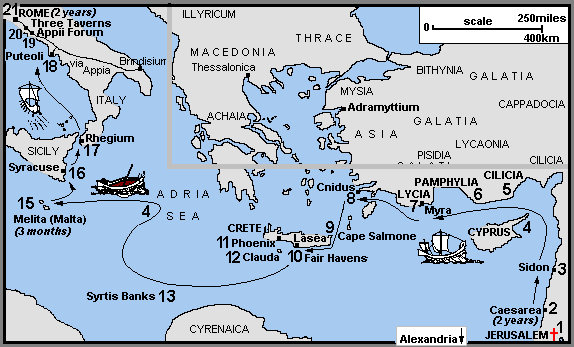 |
| Paul's Journey under Arrest from Palestine to Rome c AD58-61 http://www.ccel.org/bible/phillips/JBPhillips.htm |
 |
The Appian Way
Kleuske at nl.wikipedia [GFDL (http://www.gnu.org/copyleft/fdl.html)
or CC-BY-SA-3.0 (http://creativecommons.org/licenses/by-sa/3.0/)],
from Wikimedia Commons
|
Paul wanted to preach the gospel in Rome, and he eventually got there -- in chains, through shipwreck, and after many trials. Although he may have wished for an easier passage, he knew that God had blessed him greatly in allowing him to meet the believers in Rome and preach the message to both Jews and Gentiles in that great city. In all things, God worked for Paul's good (Romans 8:28). You can trust him to do the same for you. God may not make you comfortable or secure, but he will provide the opportunity to do his work. (Life Application Bible, p.2020)Praying God makes a way for all of us to accomplish His work through us, even if that means suffering. I am thankful for Paul's example of perseverance!
|
| Paul's Journey under Arrest from Palestine to Rome c AD58-61 from: https://www.ccel.org/bible/phillips/CN250ACTSPaultoRome.htm |
 |
| By Published by Guillaume Rouille (1518 -1589) ("Promptuarii Iconum Insigniorum") [Public domain], via Wikimedia Commons |
1) Complimenting of Agrippa II (26:2-3) - Agrippa II did know the Jewish customs and was a practicing Jew. According to Josephus, he was president of the temple and its treasures, and the appointment of the high priest. (Antiquities, 20.1.3). He did not walk as an obedient Jew as his incestuous relationship with his sister proves!
2) Paul's history of devoted Judaism (26:4-8) - He was a devout Pharisee (Philippians 3:5) and son of a Pharisee (Acts 23:6). He mentioned God raising the dead (26:8). The Greeks, Romans, and Sadducees would not have believed in the Resurrection (Acts 17:31-32; 23:8), but this is crucial to his witness because if Jesus had not been resurrected, there would be no Gospel for Paul to preach (see 1 Corinthians 15).
3) His opposition to Christianity (26:9-11) - Paul had great promise as a rabbi and was a great persecutor of the church (Galatians 1:13-14). Only divine intervention could stop him!
4) His conversion and commission (26:12-18) - All of Paul's righteousness and zeal were nothing (Philippians 3:1-11) when he met Christ on the road to Damascus. He recounts to his captive audience the encounter you have already read about in Acts 9. Paul had been resisting Christ and persecuting the church by "kicking against the goads." This was a Jewish idiom that referred to the animal's futile resistance to being prodded by a sharp stick (oxgoad). Jesus was telling Paul that he was only hurting himself by persecuting the church.
Paul was commissioned to go to the Jews and then the Gentiles and open their blind eyes, lead them from darkness to light, from the power of Satan to God, and into forgiveness of sin and sanctification through faith in Jesus Christ. This commission closely mirrors the work of the Messiah from Isaiah 35:5; 42:7, 16; 61:1. He wanted the Gentiles in his audience to know that they had an equal share in God's inheritance (Romans 8:17; Colossians 1:12). They were part of the covenant promise made to Abraham (Genesis 12:1-3; Ephesians 2:19; 1 Peter 1:3,4). This was part of the reason why the Jews were so upset with him. Gentiles equal? No way!
5) His ministry (26:19-23) - Paul responded to the heavenly vision with obedience, despite the persecution he faced along the way. All the apostles preached repentance and turning to God (2:38; 3:19; 5:31; 8:22; 11:18; 13:24; 17:30; 19:4; 20:21). He asserted that his message was just a fulfillment of the Old Testament prophecy (26:22; 24:14; 28:23) of the death and resurrection of Jesus. In that day, there was no New Testament, so they used the Old Testament to lead others to Christ and nurture them in the faith (Something, I contend, we should all do!). He summarizes the gospel in 23:23, and that can all be backed up by Old Testament Scripture:
- Christ would suffer and die for our sins (Isaiah 52:13-53:12; Corinthians 15:3)
- Christ would rise from the dead (Psalm 16:8-11;1 Corinthians 15:4,20)
- Christ would proclaim light to his people and the Gentiles (Isaiah 49:6; Acts 13:47)
6) His debate with Festus and Agrippa (26:24-29) - The above proclamation caused Festus to say Paul was out of his mind. Remember that Paul's proclamation of the Gentiles being part of God's plan also caused a strong reaction in the temple (Acts 22:21-22). But Paul just stated the facts known to all.Paul responded with concern for the souls of King Agrippa and all who heard his testimony despite Agrippa's sarcastic remark in 26:28. This caused the hearing to end, and Agrippa and Festus to conclude that Paul was innocent, but since he had appealed to Caesar, he would go to Rome.
Staying in Jerusalem was the surest and most public way to encounter the pressure of political and religious powers. Standing the test by their clear testimony is exactly what Jesus meant by the word "witness." The idea of "witnessing" in our day usually means attempting to communicate the gospel to others. But the use of this term was much different in biblical days. To "witness" was to offer prolonged public testimony. The court setting was not a way to get a public venue to preach "sermons." The trials were not really about conveying gospel information. Instead, the ordeal of public trials established the value of following Christ and thus confirmed the validity of the Christ-following movement to the common people. (Perspective on the World Christian Movement: Study Guide, Fourth Edition, by Steven C. Hawthorne, p. 50)Here is a longer excerpt that expands upon the summary above. It is well worth your time:
Boldness in Costly Public Witness
Were they faithful to the mandate Christ had given them? As Luke records it, they were to take a public stand as witnesses (Luke 24:48; Acts 1:8). To act as a "witness" in Luke's way of speaking had very little to do with personal one-on-one communication of the gospel to friends and family. Only in recent times has the term "witness" been equated with general gospel communication. Reading Luke's use of the term "witness" reveals that almost every time someone acts as a witness, they did so in a public setting.
Why was a public declaration in courts or in the streets so important? God wanted something more significant than a widespread awareness of Christ's resurrection. God was establishing an unshakable church. A witness not only asserted the facts of Jesus, they also established the profound value of following Jesus by their readiness to suffer.
The ordeal of public trial served to distinguish the movement of Christ followers, placing the entire church in public view. Ordinary men and women went on public display, along with their Christ-like character. Even their enemies recognized them "as having been with Jesus" (Acts 4:13). Their lives became an expression of the highest ideals of their people (5:13). The function of witnessing could not be reduced to a brief communicative action -- it was a process. Their obedience as witnesses transpired over weeks or months or longer.
Witnessing has to do with the paradox of shame and glory. After one courtroom appearance, Peter and his fellow witnesses rejoiced that they had been considered worthy to suffer shame for His name (5:41). Jesus relays word to Paul by Ananias that Paul was a chosen instrument "to bear My name before the Gentiles and kings and the sons of Israel." It sounds like a regal duty, but the cost is severe -- a testimony comprised of suffering. The very next phrase the Lord gives Paul is this: "for I will show him how much he must suffer for My name's sake" (9:15-16). Their shame brought Christ's glory.
The Lessons for Obedience Today
Witnessing is not so much personal sharing of the gospel as it is the public establishing of the Church. It will take more than slick communication to plant churches where there are none. The drama of Acts may be a portrait of the way any new church is planted. There may be exceptions but for the most part, the record shows that thriving movements for Jesus must emerge into the public view.
Secret movements grow weak and often disappear entirely. Movements that endure bear Christ's name boldly and at the same time display much that is recognized as the finest ideals of their people. How does this happen? It is by men and women (usually ordinary local people rather than missionaries), who are falsely accused and are brought into a setting of open testimony. At that moment, the value of following Christ is established. (Excerpt from "Acts of Obedience" by Steven C. Hawthorne from Perspectives on the World Christian Movement, Fourth Edition, edited by Ralph D. Winter and Steven C. Hawthorne, p. 139)APPLICATION
 |
| May 3, 2012: Rep. Chris Smith, left, and ChinaAid President Bob Fu, right, listen as Chinese activist Chen Guangcheng addresses a Capitol Hill committee over the phone http://www.foxnews.com/world/2013/02/21/christians-house-churches-in-china-see-erious-escalation-persecution-report/. |
- Pest and troublemaker who stirred up riots throughout the world
- Ringleader of the Nazarene sect (Jesus was from Nazareth)
None of these accusations were true, and Paul refuted them one by one and even shared the gospel and "righteousness, self-control, and the judgment to come" with Felix. This convicted Felix since he had to break up another marriage to marry his third wife, Drusilla. He was a man who lacked all these qualities and really needed Jesus!
- Desecrator of the temple

 |
Paul’s home province of Cilicia. http://www.travellinkturkey.com/cilicia.html (website no longer available) |
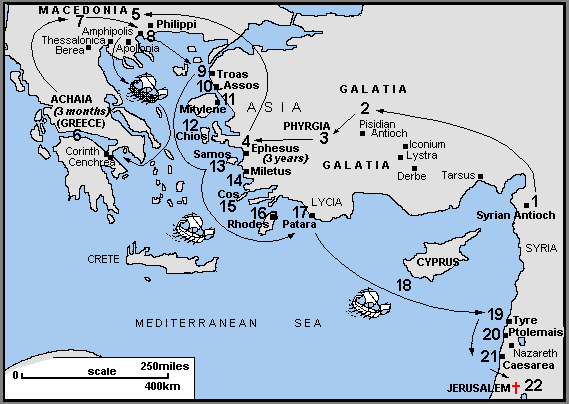 |
| http://www.ccel.org/bible/phillips/JBPhillips.htm |
Paul submitted himself to this Jewish custom to keep peace in the Jerusalem church. Although Paul was a man of strong convictions, he was willing to compromise on nonessential points, becoming all things to all people so that he might save some (2 Corinthians 9:19-23). Often a church is split over disagreements about minor issues or traditions. Like Paul, we should remain firm on Christian essentials but flexible on non-essentials. Of course, no one should violate his or her true convictions, but sometimes we need to exercise the gift of mutual submission for the sake of the gospel. (Acts 21:23, 24; p. 2006)
1) Paul rejected the idea that the Old Testament laws bring salvation to those who keep them. Our salvation is freely given by God's gracious act. We receive salvation through faith. The laws are of no value for salvation except to show us our sin.
2) Paul accepted the view that the Old Testament laws prepare us for and teach us about the coming of Jesus Christ. Christ fulfilled the law and released us from its burden of guilt. But the law still teaches us many valuable principles and gives us guidelines for grateful living. Paul was not observing the laws in order to be saved. He was simply keeping the laws as custom to avoid offending those he wished to reach with the gospel (see Romans 3:21-31; 7:4-6; 13:9, 10) For more on the law, see Galatians 3:23-29; 4:21-31. (Acts 21: 23, 24, p.2006)
The great religious feasts as described in the Old Testament and Jewish tradition are full of spiritual truth presented in the New Testament. When those festivals are reenacted in the Christian home, children have a living picture of Bible principles. They learn far better by experiencing than by only hearing.
|
| Paul's Third Missionary Journey, returning to Asia Minor and Greece c AD53-58 from: http://www.ccel.org/bible/phillips/JBPhillips.htm |
1) Broke bread - This refers to the "Lord's Supper" where they remembered the bread as Jesus' body and the wine as His blood.
2) Listened to the Apostle Paul's teaching.
3) Had fellowship - This included a "love feast."
4) Prayer is not mentioned, but I am sure they did!
And when I came to you, brethren, I did not come with superiority of speech or of wisdom, proclaiming to you the testimony of God. For I determined to know nothing among you except Jesus Christ, and Him crucified. I was with you in weakness and in fear and in much trembling, and my message and my preaching were not in persuasive words of wisdom, but in demonstration of the Spirit and of power, so that your faith would not rest on the wisdom of men, but on the power of God.I always go back to these verses when I go into situations where I want to talk about Jesus. I do not need to have all the right answers. I just need to "know and go": I need to know nothing except Jesus, His words, ways, and wounds. This means I need to immerse myself in His life and do what He says to do. Then I need to go and rely on the Holy Spirit to lead and guide me! I think we make proclaiming Christ so much more complicated than it needs to be.
Back in 2006, I was at a transition point in ministry. I was pretty burned out and bruised up from a particularly difficult ministry assignment. In my low state, I asked God to reveal His next step for me. As I was listening, He said, "Go and get a manicure and pedicure."
"What? A manicure and pedicure! God, I am too cheap to do that. I am committed to a simple lifestyle. What are you thinking? That is hardly suffering for You? Are you sure about this?"
He said, "Yes! Go!"
So, I reluctantly obeyed and made an appointment at the Hair, Body, and Sole Salon two minutes from my house. There was an opening with Sherry within a couple of hours. I speculated that maybe God just wanted me to be pampered, rest, and relax after the hectic and drama-filled 18 months of ministry I had just come through.
As I was driving there, I felt God give me a nudge, and I asked Him, "Are you sending me there so I can share with someone today?"
He said, "YES!"
"Oh, I get it! I'm ready, Lord!"
 |
| Sherry (she gave me permission to share this picture). |
I settled into the cozy atmosphere of the manicure/pedicure room at the salon. It was a dimly lit room with comfy cushions and music playing softly in the background as I sipped a beverage and ate some fruit. (Hardly what I would call suffering for Jesus!) It was just Sherry and me alone in the room, separated from the bustle and bright lights of the outer room of the salon with hairdryers blasting and a cacophony of chit-chat from about a dozen stylists.
Sherry and I hit it off immediately as she pampered my feet in rose water. Our conversation eventually led to the subject of her son who was in a load of trouble. I asked her, "What is your son's name? I want to pray for him."
She burst into a smile and started talking excitedly. "Oh, you pray? Do you also read the Bible? Do you know it very well? I have been reading the Bible every night for the last few months, and I am on the book of Job (she pronounced it like the place you have employment) or is it Job (pronounced like the man in the Bible)? I don't really understand it. I have some questions."
I sat there, utterly amazed. She had been reading it all on her own? She had even made it through Leviticus! Oh my! She was a true seeker. I replied and tried to remain calm, "Yes, I do know the Bible. I am sort of a Bible teacher."
She proceeded to ask me a load of questions. The nice thing about a manicure AND a pedicure is that you are together for about 2 1/2 hours, and we were never interrupted while in that room exclusively devoted to manicures and pedicures. As a result, we got into a very deep discussion. I was able to give her an overview of the Scriptures starting from Genesis. Even though she had not gotten to the Gospel and the full revelation of Jesus, I used the Passover lamb in Exodus and the sacrifices in Leviticus to point her to Him!
By this time, we had transitioned to a manicure, and I could not write anything down during or afterward, but I booked another appointment and subsequent appointments until she came to Christ about five months later! I would say it was worth the cost!
God is very faithful to lead us, just as He led Paul; and we can rely on Him to give us the words that demonstrate His power to a lost and dying world! We just need to listen and obey!PRAYER


