Showing posts sorted by relevance for query Passover. Sort by date Show all posts

Friday, April 1, 2011

Leviticus 23 & 24 - The Feasts of Israel & Regulations for the Sanctuary

LINK: Leviticus 23 & 24

BACKGROUND

Leviticus 23 - The Feasts of Israel

Here is a "Feasts Chart" that will give you a great overview of this chapter as well as the scarlet thread significance of each of the feasts. Feel free to print it out.


The feasts allowed the people of Israel to have "appointed" times throughout the year to look back upon God's faithfulness in their history and forward to the time of the Messiah. There were seven. The first in the cycle was Passover. Here is a link to the dates for the feasts that vary from year to year: Jewish Feasts.

Spring Feasts - Passover, Unleavened Bread, and Firstfruits of Barley and Wheat 


Passover and Unleavened Bread are often just lumped together and called "Passover/Pesach" because they occur together over an eight day period.

The Passover looks back at the redemption of the firstborn when God "passed over" the Israelite homes sparing the firstborns of the household during the last plague. It looks forward to Christ's redeeming death. The wine of Passover signifies Christ's blood.

The Feast of Unleavened Bread was to begin the morning after the Passover lamb was sacrificed. It commemorated the flight from Egypt. You might remember that God told them not to leaven their bread (Exodus 12:14-20).  It looks at leaven as a symbol of sin. The Jews do not eat anything with leaven in it for seven days. They clear their houses of it. It represents Jesus as the sinless Bread of Life. This combined with Passover is the feast where all males were required to be in Jerusalem.

The Feast of First Fruits is celebrated on the day after the Sabbath following Passover. It was the first fruits of the barley harvest that occurs in March-April. It represents Jesus' resurrection. He was the "first fruits" of the dead (1 Cor. 15:20). This started seven weeks of gladness that ended at the wheat harvest of Shavuot

Feast of Weeks - Wheat Harvest (Pentecost or Shavuot) 

Sometimes called the Feast of Harvest or Feast of the First Fruits, it falls 50 days after Passover and originally celebrated the end of the seven-week grain-harvesting season. In later tradition, it also celebrated the giving of the Law to Moses on Mount Sinai. This was a feast that required that all males attend the central place of worship in Jerusalem. It was the day when God-fearing Jews from many peoples saw the "first fruits" of the Holy Spirit in Acts 2:1-13.

Fall Feasts - Trumpets, Day of Atonement, and Booths

Feast of Trumpets (Rosh Hashanah

This day marks the beginning of the Jewish year and opens the Ten Days of Penitence called "High Holy Days" or "Days of Awe" which close with Yom Kippur. One tradition is called tashlich which is the Hebrew word for "thou shalt cast into the seas." Jews traditionally go to a river or body of water and cast rocks which designate sins for which they are sorry. We did this when the kids were small, and it was quite fun!

Day of Atonement (Yom Kippur

This day marks the end of the Ten Days of Penitence that began with Rosh Hashanah. It is a day of rest and was discussed in Leviticus 16. It is for repentance and fasting.

Feast of Tabernacles/Booths (Sukkoth

This feast looks back at the wandering of the Israelites in the wilderness. Sukkoth was the first stopping place for the Israelites. Sukkoth means "huts" in Hebrew. Jacob journeyed there, and he built himself a house and made booths for his livestock (Genesis 33:17). It is a seven day feast where Jews live in huts. It is my favorite! This is another feast that required all males to attend the central place of worship in Jerusalem. This feast also includes a water festival in which Jesus proclaimed He was the Living Water (John 7:37-38). 

NOTE: All feasts begin at sundown on the previous day

Leviticus 24 - This chapter covers regulations for the sanctuary.

REFLECTION


In 1992 -1993, we got together with 25 other people and celebrated the feasts together. It was a blast! I heartily recommend it. They contain so much rich symbolism and spiritual truth. I was amazed at how much it helped me in my study of John a few years later since many of the important things that Jesus did during his public ministry occurred during these feasts!


APPLICATION

Celebrating Biblical Feasts by Martha Zimmerman is an excellent tool for understanding the feasts, and their significance to us as New Testament believers. We used it when we did it with our group.

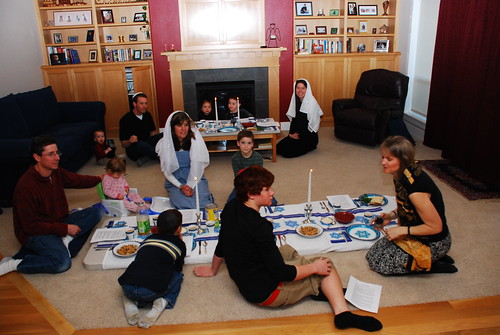
You might want to consider celebrating some of these feasts with family and friends. The pictures above were from a Passover that we did before Easter in 2008 with some Bible Book Club families!

PRAYER

Lord, we worship You and adore You as our living God. Thank You that You created these feasts to remind us of Your faithfulness in the past and the fulfillment of Your promises in the future. Amen.

Saturday, January 26, 2013

Matthew 26 - The Garden, Arrest, and Jewish Trials


LINK: Matthew 26

BACKGROUND 


Tuesday of Holy Week


207. Religious leaders plot to kill Jesus: Matthew 26:1-5, Mark 14:1-2, Luke 22:1-2

It is two days before the Passover and unleavened bread (I place this at Tuesday, but some commentators think this is Wednesday), and the religious leaders have decided to arrest and kill Jesus, but their sly plan was to wait until the religious pilgrims from the Passover feast had gone home. 


182. A Woman Anoints Jesus with Perfume: Matthew 26:6-13, Mark 14:3-9, John 12:1-11

Chronologically, this event happened before Jesus rode into Jerusalem on a donkey, but the gospel accounts by Matthew and Mark place it here and can only be explained as a flashback. Some commentators believe it was put here in the Matthew and Mark accounts to contrast the worship of Mary with the hostility of the religious leaders or to show why Judas was so interested in obtaining more funds. John’s account is in the correct place chronologically (John 12:1-11).

This event draws Jesus' public ministry to a close. Mary's anointing of Jesus signified her anointing for the coming sacrifice of Jesus on the cross. This is not to be confused with the account in Luke 7:36-50, where the sinful woman anointed Jesus in the house of Simon the Pharisee in Galilee. The anointing in this event is by Mary, probably the sister of Lazarus and Martha, a virtuous woman. Sometimes people are confused because both events happened in the home of a man named Simon, which was a common name in those days.  

It is six days before the Passover. Some gospel harmonies place this day as Friday and some as Saturday before Palm Sunday. People would arrive early because of the large number of pilgrims coming for ritual purification before the feast.  Jesus has just returned from Ephraim and is attending a dinner in Lazarus' honor at Simon the leper's house (Jesus had probably healed him). 

It was unusual for a woman to be at the table with guests. The flask contained .5 liter or a pint of pure nard imported from the mountains of East India. It was only opened on special occasions. Even though the anointing of special guests was customary at wedding feasts, the costly perfume would have been poured on the head of a king and not on the head (Matthew and Mark) and feet (John) of an upstart teacher like Jesus. 

Judas objected, but that was because he had been dipping in the money box! Jesus knew all that though (John 2:24, 25; 6:64). The Matthew and Mark accounts say it was "some disciples" and "some" who were indignant, but John says it was Judas specifically. 

Jesus told them to leave Mary alone because she was anointing Him for burial. There is an obvious contrast between Judas' secret greed and Mary's open and giving sacrifice. 

The John account adds that a large crowd gathered to see Jesus and Lazarus whom the religious leaders were also planning to kill. 

208. Judas agrees to betray Jesus: Matthew 26:14-16, Mark 14:10-11, Luke 22:3-6

What was Judas' motive? We will never really know. It may have been money (John 12:6). Thirty silver coins were the price paid for the redemption of a slave (Exodus 21:32) and were prophesied as the price to be paid for Jesus, the rejected Shepherd (Zechariah 10:12). It prophesied that one of the Messiah's close friends would betray Him (Psalm 41:9; 55:12-14). 

Thursday before Sunset

209. Disciples prepare for the Passover: Matthew 26:17-19, Mark 14:12-16. Luke 22:7-13


The Feast of Unleavened Bread was seven days long. On the first day, Passover lambs were sacrificed (Mark 14:12). Passover and this Feast are often lumped together and just called Passover (Luke 22:1,7). See below for a fun thing to do on the first day of the Feast of Unleavened Bread!

We do not know where the "Upper Room" was located other than it was in the city of Jerusalem. 


They purchased and prepared the Passover food. Have you ever celebrated Passover? It is a great object lesson. We often do it on Holy Week. Here are pictures of us celebrating with others. 


Leonardo da Vinci (1452-1519) - The Last Supper (1495-1498)
Leonardo da Vinci [Public domain], via Wikimedia Commons
211. Jesus and the disciple share the Last Supper: Matthew 26:20-30, Mark 14:17-26, Luke 22:14-30, John 13:21-30

Leonardo da Vinci's painting did not get it right. They were all reclining and not sitting at a table (Matthew 26:20), but it is still a beautiful work of art!

John's account is the only one that mentions that Jesus was "troubled in spirit" (the Greek word, etarachthē, means stirred or agitated) when he identified that someone would betray Him. John, as the disciple Jesus loved, was reclining at Jesus' bosom and would have been more able to sense Jesus' spirit at the time. Luke is the only one who records Jesus saying "woe" (judgment) on the man who does the betraying. How disconcerting to learn that one of their own would betray Jesus.


The Matthew, Mark, and John accounts record the betrayer as the one who dips together with Jesus in the bowl. John's account records Him doing this act and giving the morsel to Judas. It was a "final extension of grace to Judas. A host's giving a morsel of bread to a guest was a sign of friendship" (The Bible Knowledge Commentary, John 13:25-27), but Judas did not take it as that and Satan entered him (John 13:27). John is the only gospel writer that records this and that the disciples still did not know Judas was the betrayer. 


How astounding that Luke would record a dispute about who was the greatest after Jesus had just said that someone would betray Him (Luke 22:24-30). Jesus told them this talk was "pagan thinking." The way UP to greatness was DOWN through service. In fact, it is "lowly service" in the Greek! Eventually, they would sit on thrones judging the twelve tribes in His Kingdom (Luke 22:30, Matthew 19:28). 


During the meal, Jesus instituted the Lord's Supper where the wine would represent the blood of the covenant and the unleavened bread, His body. The John account does not record Jesus' words regarding this. The Lord's Supper is to be done in remembrance of this (1 Corinthians 11:23-26). It is to be a memorial feast where believers are reminded that Jesus gave His body and blood for the redemption of the world! It is also celebrated to look forward to the day when He will come again. Lastly, it is a time when we can look within, examine our hearts, and repent of known sin (1 Corinthians 11:27-32).  Jesus was the Passover lamb, sacrificed for us, let us celebrate the feast (John 1:29, 1 Corinthians 5:7-8)!


Here is the general order of the last supper in 13 steps 
[some books show more steps, others fewer steps, so this is a general guideline]:
  1. The head of the company, Jesus in this case, opens with a prayer and
  2. Gives the 1st cup of wine for everyone in the company to drink.
  3. The head of the company washes his hands.
  4. The head of the company dips some of the bitter herbs into the salt water or vinegar and speaks a blessing, eats some of the herbs, and hands them to the others.
  5. The unleavened bread is broken into pieces, reserving half to be eaten after supper, called the after dish.
  6. The 2nd cup is filled and the youngest in the company (John) is instructed to ask questions about the significance of the Passover.
  7. Psalms 113 and 114 are sung.
  8. The 3rd cup of wine is filled, followed by prayer, and they all drink the cup.
  9. Everyone washes his hands.
  10. Supper begins with eating the unleavened bread and bitter herbs and the lamb. Everyone in the group must eat at least an olive size portion of the lamb. All the lamb is to be consumed or destroyed. no bones of the lamb are to be broken.
  11. The after-dish of the bread broken earlier is eaten. It is believed this is where Jesus said, "Take eat, this is my body."
  12. The 4th cup of wine is the point when Jesus told them to all drink of it, this was his blood.
  13. Conclude with hymns and prayers. Psalms 115-118 and the Great Hallel - Psalm 136.
222. Jesus again predicts Peter's denial: Matthew 26:31-35, Mark 14:27-31

Jesus reiterated what He had already said in Luke 22:31-38 (Event #212. Also, John 13:31-38.) and John 16:31-31 (Event #218). This would be fulfilled in Matthew 26:56 (Event #224) and Matthew 26:69-75 (Events #227. Also Mark 14:66-72, Luke 22:54-65, John 18:25-27.). 

After 9 pm until Pre-Dawn

223. Jesus agonizes in the garden: Matthew 26:36-46, Mark 14:32-42, Luke 22:39-46

Here is a meditation of Matthew 26:36-46 from Contemplative at Home:


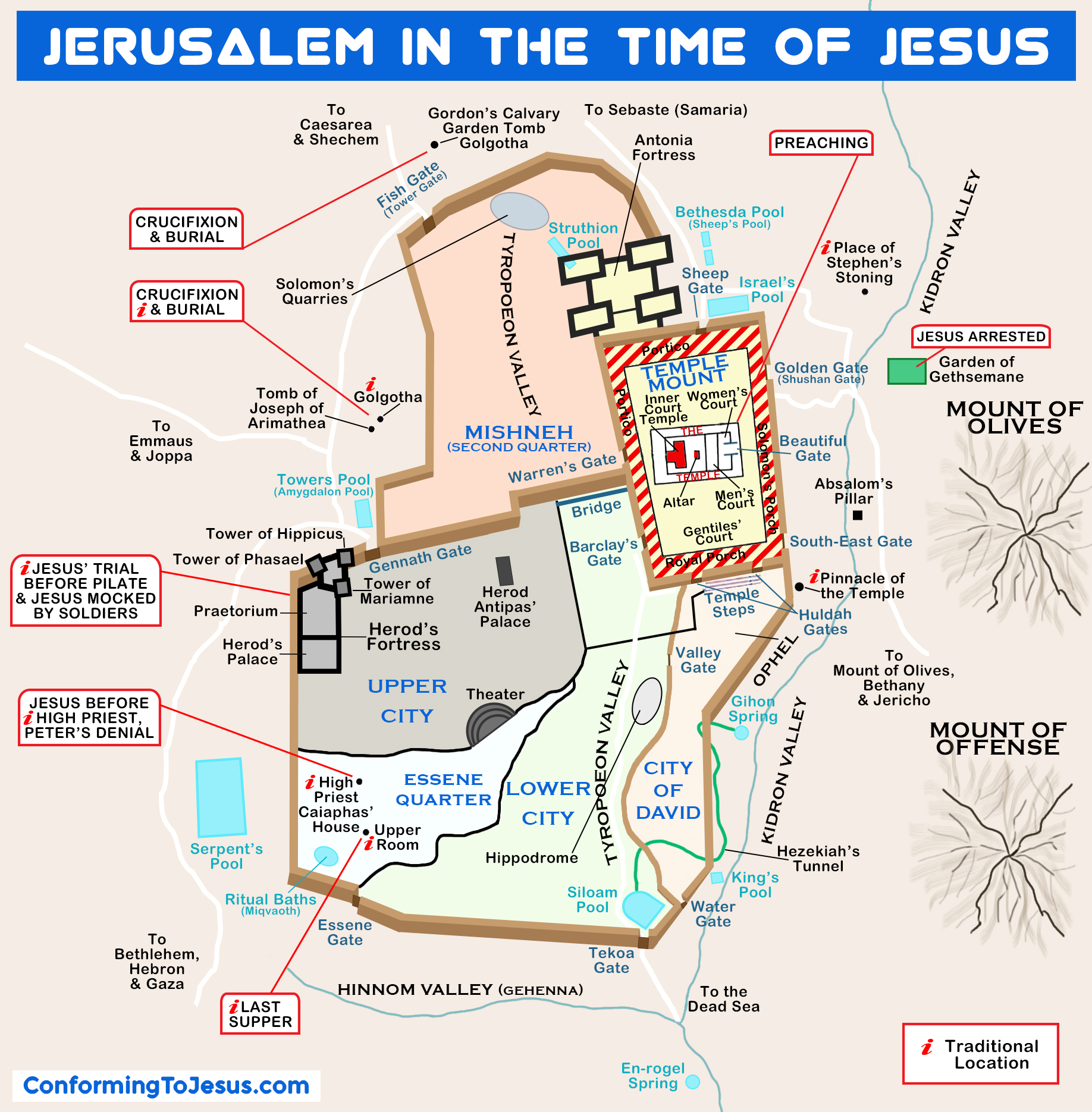
After the Last Supper in the Upper Room (Possibly #3 on the map), they went to the Garden of Gethsemane (#4). Gethsemane means "an oil press." Obviously, the garden contained an olive grove and Jesus had often gone there with His disciples (John 18:1-2). He took the same disciples that He had taken to the transfiguration on the mountain and the raising of Jairus' daughter (Matthew 1 watch. He rebukes Peter telling him that his "spirit is willing but his flesh is weak" (Matthew 26:41; Mark 14:38). God is not finished with Peter yet. He was eager with his mouth but not able to follow through with his actions as we will see very soon. 

Jesus' prayers were not because He was afraid of death, the "cup" He would endure would be taking on the sins of the world (John 18:11; 1 Peter 2:24). He was made sin and a curse for mankind (2 Corinthians 5:21; Galatians 3:13). He would also be forsaken by the Father (Matthew 27:46) at that moment (for a holy God cannot abide with sin). Jesus willingly drank this cup but not without agony. That would be a hard cup for the sinless Jesus, vitally connected to the Father! But it was necessary for us (Join the Bible Book Club for the book of Romans, and we will discuss this further!). 

The Luke account is a little different. It does not record the three prayers, and it also said that "an angel from heaven appeared to Him, strengthening Him," and that in the agony of His prayer "His sweat became like drops of blood, falling down upon the ground" (Luke 22:43-44). This was no easy task for Jesus. 

224. Jesus is betrayed and arrested: Matthew 26:47-56, Mark 14:43-52, Luke 22:47-53, John 18:1-11.

Here is a meditation/imaginative contemplation of John 18:1-14 from Contemplative at Home:


Judas brings a large crowd, and the John account explains it was not only from the Jewish religious leaders but also from the Roman cohort (about 600 soldiers).

When they said they were looking for Jesus the Nazarene, John records that Jesus responded by saying, "I am." The NASB adds He in italics indicating that this word is not in the original Greek. If you are reading this in many other versions (including the NIV) they say “I am he” without italics and a very important thing is lost in the translation. Jesus was asserting His deity by saying “I am” (Exodus 3:14; John 8:58)!  I think this is why the people fell to the ground!

Matthew, Mark, and Luke mention Judas betraying Jesus with a kiss. John mentions Peter's brash act of cutting off the slave's right ear and even mentions his name! Jesus was arrested willingly and without any harm to His disciples fulfilling His prayer in John 17:2 (John 18:9). 

From: The Bible Knowledge Commentary New Testament, p. 84

Religious (Jewish) Trials 

226. Caiaphas questions Jesus: Matthew 26:57-68, Mark 14:53-65

Religious Trial Two

This is a brief trial while the religious leaders gathered testimony against Him. They found two false witnesses (Deuteronomy 19:15-21) who testified that He said, "I will destroy this temple (sanctuary) made with hands and in three days I will build another made without hands" (Mark 14:58). Jesus had said this about three years earlier (John 2:19). Speaking against the temple was the cause of the death of Stephen (Acts 6:12-14; 7:45-50), but Jesus was referring to His body. 

Jesus did not respond to this charge, fulfilling Isaiah 53:7. He also led an example for us, as described in 1 Peter 2:18-23. 

Since this charge was not incriminating enough. Caiaphas put Jesus under oath (Exodus 20:7; Leviticus 19:12; Numbers 30:2) and asked if He was the Son of God. Since Jesus had already asserted this (John 10:30-33), He affirmed it quoting Psalm 110:1 and Daniel 7:13, prophetic messianic passages predicting his resurrection, ascension, and return to His place of glory. The significance of this claim is beautifully summed up in an article by Brad Bromling: 

To identify Jesus as the Son of God is to acknowledge His genealogical connection to Israel, His right to the throne of David, and His unparalleled nearness to God. To confess that Jesus is the Son of God is to declare as true Jesus’ claim: “He who has seen me has seen the Father” (John 14:9).

Caiaphas passed condemnation of death with this blasphemous statement. This marks the beginning of Jesus' physical abuse. 

Early Friday Morning before Dawn (when the "cock crowed")

227. Peter denies knowing Jesus: Matthew 26:69-75, Mark 14:66-72, Luke 22:54-65, John 18:25-27

It is just before dawn, and these denials occurred either during Jesus's trial with Annas (John 18:12-24) or Caiphas (Matthew 26:57-68; Mark 14:53-65).  The three denials are in such contrast to his boast to lay down his life for Jesus (John 13:37) and the cutting off of Malchus' ear during the arrest (John 18:10). How ironic that a relative of Malchus would ask the final question that prompted the final denial! Don't lose hope on Peter though. Those three denials will be followed by three affirmations by Peter in John 21. Stay tuned!

REFLECTION

Many years ago, two friends and I started a group called Watchwomen. Our goal was to encourage women to keep watching and praying. We did not share prayer requests like most prayer meetings do. We just waited on God and praised and prayed in response for two hours.

Much of the time was spent listening to God, and that is tough for many people to do, especially women who are "doers."  But Jesus said this was the "better thing" (Luke 10:41).

Watching and praying is a discipline. The spirit may be willing, but the flesh is weak. 

APPLICATION

Put aside time to "watch and pray" today. Purpose in your heart to spend some undisturbed time listening to God. Now, this may be five minutes or five hours. The time is up to you!  Do not defeat yourself by taking on more than you can chew. Just have some protected time with God. 

You also might like to follow this audio prayer exercise based on the Last Supper: Taken, Blessed, Broken, Given Examen.

You can also download it in written form.

It comes from the God in All Things Website

PRAYER

Lord, we watch and pray, expectantly for You. Amen. 

Tuesday, February 12, 2013

Mark 14 - Anointing, Agonizing, and Arrest

LINK: Mark 14


BACKGROUND 


Tuesday of Holy Week


207. Religious leaders plot to kill Jesus: Matthew 26:1-5, Mark 14:1-2, Luke 22:1-2

It is two days before the Passover and unleavened bread (I place this at Tuesday, but some commentators think this is Wednesday), and the religious leaders have decided to arrest and kill Jesus, but their sly plan was to wait until the religious pilgrims from the Passover feast had gone home. 


182. A Woman Anoints Jesus with Perfume: Matthew 26:6-13, Mark 14:3-9, John 12:1-11

Chronologically, this event happened before Jesus rode into Jerusalem on a donkey, but the gospel accounts by Matthew and Mark place it here and can only be explained as a flashback. Some commentators believe it was put here in the Matthew and Mark accounts to contrast the worship of Mary with the hostility of the religious leaders or to show why Judas was so interested in obtaining more funds. John’s account is in the correct place chronologically (John 12:1-11).

This event draws Jesus' public ministry to a close. Mary's anointing of Jesus signified her anointing for the coming sacrifice of Jesus on the cross. This is not to be confused with the account in Luke 7:36-50, where the sinful woman anointed Jesus in the house of Simon the Pharisee in Galilee. The anointing in this event is by Mary, probably the sister of Lazarus and Martha, a virtuous woman. Sometimes people are confused because both events happened in the home of a man named Simon, which was a common name in those days.  

It is six days before the Passover. Some gospel harmonies place this day as Friday and some as Saturday before Palm Sunday. People would arrive early because of the large number of pilgrims coming for ritual purification before the feast.  Jesus has just returned from Ephraim and is attending a dinner in Lazarus' honor at Simon the leper's house (Jesus had probably healed him). 

It was unusual for a woman to be at the table with guests. The flask contained .5 liter or a pint of pure nard imported from the mountains of East India. It was only opened on special occasions. Even though the anointing of special guests was customary at wedding feasts, the costly perfume would have been poured on the head of a king and not on the head (Matthew and Mark) and feet (John) of an upstart teacher like Jesus. 

Judas objected, but that was because he had been dipping in the money box! Jesus knew all that though (John 2:24, 25; 6:64). The Matthew and Mark accounts say it was "some disciples" and "some" who were indignant, but John says it was Judas specifically. 

Jesus told them to leave Mary alone because she was anointing Him for burial. There is an obvious contrast between Judas' secret greed and Mary's open and giving sacrifice. 

The John account adds that a large crowd gathered to see Jesus and Lazarus whom the religious leaders were also planning to kill. 

208. Judas agrees to betray Jesus: Matthew 26:14-16, Mark 14:10-11, Luke 22:3-6

What was Judas' motive? We will never really know. It may have been money (John 12:6). Thirty silver coins were the price paid for the redemption of a slave (Exodus 21:32) and were prophesied as the price to be paid for Jesus, the rejected Shepherd (Zechariah 10:12). It prophesied that one of the Messiah's close friends would betray Him (Psalm 41:9; 55:12-14). 

Thursday before Sunset

209. Disciples prepare for the Passover: Matthew 26:17-19, Mark 14:12-16. Luke 22:7-13


The Feast of Unleavened Bread was seven days long. On the first day, Passover lambs were sacrificed (Mark 14:12). Passover and this Feast are often lumped together and just called Passover (Luke 22:1,7). See below for a fun thing to do on the first day of the Feast of Unleavened Bread!

We do not know where the "Upper Room" was located other than it was in the city of Jerusalem. 


They purchased and prepared the Passover food. Have you ever celebrated Passover? It is a great object lesson. We often do it on Holy Week. Here are pictures of us celebrating with others. 


Leonardo da Vinci (1452-1519) - The Last Supper (1495-1498)
Leonardo da Vinci [Public domain], via Wikimedia Commons

211. Jesus and the disciple share the Last Supper: Matthew 26:20-30, Mark 14:17-26, Luke 22:14-30, John 13:21-30

Leonardo da Vinci's painting did not get it right. They were all reclining and not sitting at a table (Matthew 26:20), but it is still a beautiful work of art!

John's account is the only one that mentions that Jesus was "troubled in spirit" (the Greek word, etarachthē, means stirred or agitated) when he identified that someone would betray Him. John, as the disciple Jesus loved, was reclining at Jesus' bosom and would have been more able to sense Jesus' spirit at the time. Luke is the only one who records Jesus saying "woe" (judgment) on the man who does the betraying. How disconcerting to learn that one of their own would betray Jesus.


The Matthew, Mark, and John accounts record the betrayer as the one who dips together with Jesus in the bowl. John's account records Him doing this act and giving the morsel to Judas. It was a "final extension of grace to Judas. A host's giving a morsel of bread to a guest was a sign of friendship" (The Bible Knowledge Commentary, John 13:25-27), but Judas did not take it as that and Satan entered him (John 13:27). John is the only gospel writer that records this and that the disciples still did not know Judas was the betrayer. 


How astounding that Luke would record a dispute about who was the greatest after Jesus had just said that someone would betray Him (Luke 22:24-30). Jesus told them this talk was "pagan thinking." The way UP to greatness was DOWN through service. In fact, it is "lowly service" in the Greek! Eventually, they would sit on thrones judging the twelve tribes in His Kingdom (Luke 22:30, Matthew 19:28). 


During the meal, Jesus instituted the Lord's Supper where the wine would represent the blood of the covenant and the unleavened bread, His body. The John account does not record Jesus' words regarding this. The Lord's Supper is to be done in remembrance of this (1 Corinthians 11:23-26). It is to be a memorial feast where believers are reminded that Jesus gave His body and blood for the redemption of the world! It is also celebrated to look forward to the day when He will come again. Lastly, it is a time when we can look within, examine our hearts, and repent of known sin (1 Corinthians 11:27-32).  Jesus was the Passover lamb, sacrificed for us, let us celebrate the feast (John 1:29, 1 Corinthians 5:7-8)!


Here is the general order of the last supper in 13 steps 
[some books show more steps, others fewer steps, so this is a general guideline]:
  1. The head of the company, Jesus in this case, opens with a prayer and
  2. Gives the 1st cup of wine for everyone in the company to drink.
  3. The head of the company washes his hands.
  4. The head of the company dips some of the bitter herbs into the salt water or vinegar and speaks a blessing, eats some of the herbs, and hands them to the others.
  5. The unleavened bread is broken into pieces, reserving half to be eaten after supper, called the after dish.
  6. The 2nd cup is filled and the youngest in the company (John) is instructed to ask questions about the significance of the Passover.
  7. Psalms 113 and 114 are sung.
  8. The 3rd cup of wine is filled, followed by prayer, and they all drink the cup.
  9. Everyone washes his hands.
  10. Supper begins with eating the unleavened bread and bitter herbs and the lamb. Everyone in the group must eat at least an olive size portion of the lamb. All the lamb is to be consumed or destroyed. no bones of the lamb are to be broken.
  11. The after-dish of the bread broken earlier is eaten. It is believed this is where Jesus said, "Take eat, this is my body."
  12. The 4th cup of wine is the point when Jesus told them to all drink of it, this was his blood.
  13. Conclude with hymns and prayers. Psalms 115-118 and the Great Hallel - Psalm 136.
      222. Jesus again predicts Peter's denial: Matthew 26:31-35, Mark 14:27-31

      Jesus reiterated what He had already said in Luke 22:31-38 (Event #212. Also, John 13:31-38.) and John 16:31-31 (Event #218). This would be fulfilled in Matthew 26:56 (Event #224) and Matthew 26:69-75 (Events #227. Also Mark 14:66-72, Luke 22:54-65, John 18:25-27.). 

      After 9 pm until Pre-Dawn

      223. Jesus agonizes in the garden: Matthew 26:36-46, Mark 14:32-42, Luke 22:39-46

      After the Last Supper in the Upper Room (Possibly #3 on the map), they went to the Garden of Gethsemane (#4). Gethsemane means "an oil press." Obviously, the garden contained an olive grove and Jesus had often gone there with His disciples (John 18:1-2). He took the same disciples that He had taken to the transfiguration on the mountain and the raising of Jairus' daughter (Matthew 17, Luke 8:49-56): Peter, James, and John. All three accounts record that Jesus told them to pray, but Luke's account adds, "that you may not enter into temptation." Matthew and Mark record Him going away for three agonizing prayers and each time finding His disciples asleep on the watch. He rebukes Peter telling him that his "spirit is willing but his flesh is weak" (Matthew 26:41; Mark 14:38). God is not finished with Peter yet. He was eager with his mouth but not able to follow through with his actions as we will see very soon. 

      Jesus' prayers were not because He was afraid of death, the "cup" He would endure would be taking on the sins of the world (John 18:11; 1 Peter 2:24). He was made sin and a curse for mankind (2 Corinthians 5:21; Galatians 3:13). He would also be forsaken by the Father (Matthew 27:46) at that moment (for a holy God cannot abide with sin). Jesus willingly drank this cup but not without agony. That would be a hard cup for the sinless Jesus, vitally connected to the Father! But it was necessary for us (Join the Bible Book Club for the book of Romans, and we will discuss this further!). 

      The Luke account is a little different. It does not record the three prayers, and it also said that "an angel from heaven appeared to Him, strengthening Him," and that in the agony of His prayer "His sweat became like drops of blood, falling down upon the ground" (Luke 22:43-44). This was no easy task for Jesus. 

      224. Jesus is betrayed and arrested: Matthew 26:47-56, Mark 14:43-52, Luke 22:47-53, John 18:1-11.

      Judas brings a large crowd, and the John account explains it was not only from the Jewish religious leaders but also from the Roman cohort (about 600 soldiers).

      When they said they were looking for Jesus the Nazarene, John records that Jesus responded by saying, "I am." The NASB adds He in italics indicating that this word is not in the original Greek. If you are reading this in many other versions (including the NIV) they say “I am he” without italics and a very important thing is lost in the translation. Jesus was asserting His deity by saying “I am” (Exodus 3:14; John 8:58)!  I think this is why the people fell to the ground!

      Matthew, Mark, and Luke mention Judas betraying Jesus with a kiss. John mentions Peter's brash act of cutting off the slave's right ear and even mentions his name! Jesus was arrested willingly and without any harm to His disciples fulfilling His prayer in John 17:2 (John 18:9). 

      From: The Bible Knowledge Commentary New Testament, p. 84

      Religious (Jewish) Trials 

      226. Caiaphas questions Jesus: Matthew 26:57-68, Mark 14:53-65

      Religious Trial Two

      This is a brief trial while the religious leaders gathered testimony against Him. They found two false witnesses (Deuteronomy 19:15-21) who testified that He said, "I will destroy this temple (sanctuary) made with hands and in three days I will build another made without hands" (Mark 14:58). Jesus had said this about three years earlier (John 2:19). Speaking against the temple was the cause of the death of Stephen (Acts 6:12-14; 7:45-50), but Jesus was referring to His body. 

      Jesus did not respond to this charge, fulfilling Isaiah 53:7. He also led an example for us, as described in 1 Peter 2:18-23. 

      Since this charge was not incriminating enough. Caiaphas put Jesus under oath (Exodus 20:7; Leviticus 19:12; Numbers 30:2) and asked if He was the Son of God. Since Jesus had already asserted this (John 10:30-33), He affirmed it quoting Psalm 110:1 and Daniel 7:13, prophetic messianic passages predicting his resurrection, ascension, and return to His place of glory. The significance of this claim is beautifully summed up in an article by Brad Bromling: 

      To identify Jesus as the Son of God is to acknowledge His genealogical connection to Israel, His right to the throne of David, and His unparalleled nearness to God. To confess that Jesus is the Son of God is to declare as true Jesus’ claim: “He who has seen me has seen the Father” (John 14:9).

      Caiaphas passed condemnation of death with this blasphemous statement. This marks the beginning of Jesus' physical abuse. 

      Early Friday Morning before Dawn (when the "cock crowed")

      227. Peter denies knowing Jesus: Matthew 26:69-75, Mark 14:66-72, Luke 22:54-65, John 18:25-27

      It is just before dawn, and these denials occurred either during Jesus's trial with Annas (John 18:12-24) or Caiphas (Matthew 26:57-68; Mark 14:53-65).  The three denials are in such contrast to his boast to lay down his life for Jesus (John 13:37) and the cutting off of Malchus' ear during the arrest (John 18:10). How ironic that a relative of Malchus would ask the final question that prompted the final denial! Don't lose hope on Peter though. Those three denials will be followed by three affirmations by Peter in John 21. Stay tuned!

      REFLECTION

      Jesus did not respond to Caiaphas, leaving us an example to follow. I have to admit, I used to respond to every accusation made against me. I have learned the hard way to just follow Jesus' example and to not "revile in return" (1 Peter 2:21-23). It is so hard for me because I like the truth to be known, especially about me!  You know what they say, "A false report gets halfway around the world before the truth can get its shoes on." Sometimes it is best to just walk away from the false rumors and reports and just trust that God is the ultimate Judge, and He is the One the false witnesses will have to answer to in the end. 


      But it is hard to not want to defend yourself. I remember a wise man, Glenn Shepherd, saying once, "God is more concerned with your character than your reputation." That has always stuck with me, and I have learned over the years that not responding to false reports helps me to grow in character and become more like Jesus. 


      APPLICATION

      You might like to follow this audio prayer exercise based on the Last Supper: Taken, Blessed, Broken, Given Examen.

      You can also download it in written form.

      It comes from the God in All Things Website

      Do you "revile in return" for being falsely accused? Pray through 1 Peter 2:18-25 below.


      PRAYER

      Servants, be submissive to your masters with all respect, not only to those who are good and gentle, but also to those who are unreasonable. For this finds favor, if for the sake of conscience toward God a person bears up under sorrows when suffering unjustly. For what credit is there if, when you sin and are harshly treated, you endure it with patience? But if when you do what is right and suffer for it you patiently endure it, this finds favor with God. For you have been called for this purpose, since Christ also suffered for you, leaving you an example for you to follow in His steps, who committed no sin, nor was any deceit found in His mouth; and while being reviled, He did not revile in return; while suffering, He uttered no threats, but kept entrusting Himself to Him who judges righteously; and He Himself bore our sins in His body on the cross, so that we might die to sin and live to righteousness; for by His wounds you were healed. For you were continually straying like sheep, but now you have returned to the Shepherd and Guardian of your souls. (1 Peter 2:18-25) 

      Thursday, February 28, 2008

      Exodus 11 & 12 - The Passover

      READING: Exodus 11-12

      Here comes the climax of the plagues -- the death of the firstborn of every family. And finally, because of this death, Pharaoh let the Israelites leave Egypt, taking with them ALL of the people from the oldest to the youngest, as well as all the livestock, just like Moses requested in the first place. And to top it off, they also took many riches from Egypt that the Egyptian people gave to them. We will see later that many Egyptians joined them on this journey as well.

      God had dramatically demonstrated His power and authority through the plagues and had preserved the lives of the Israelites while destroying the life and property of the Egyptians (not to mention the validity of the Egyptian gods). Imagine the excitement Moses must have felt as about two million people followed him out of Egypt! God was doing just what He had told Moses He would do! They had an appointment to keep with God at Mt. Sinai (aka Horeb), where God had appeared to Moses in the burning bush back in chapter three. And now they were on their way!

      BACKGROUND NOTES:
      11:3 - Moses was greatly esteemed in Egypt. Although Pharaoh's heart was hardened, the hearts of many others were not. They saw that Moses had a more powerful God they theirs. They respected Moses. And the LORD softened the hearts of the Egyptians toward the Hebrew people.

      11:7 - a dog shall not even bark - A proverbial saying meaning that no one would offer the least resistance when Israel left Egypt (Ryrie).

      12:2 ff - Passover is such a significant event that it will define the beginning of the Hebrew year from now on. It is an event that is to be celebrated every year among the people of Israel.

      12:15 ff - The Feast of Unleavened Bread is a seven day commemoration that begins the evening of Passover and is also to be celebrated annually. Leaven is a symbol of sin and is to be cleared completely from all homes on the first day of this feast and kept out until the feast week is over. Likewise, after we are cleansed by the blood of Christ, we are to walk in holiness. (See 1 Cor 5:7.)

      Scarlet Thread of Redemption - Passover is a tremendous celebration for the children of Israel and a beautiful illustration of the redemption Christ accomplished at Calvary.

      • At Passover, Israel celebrates liberation from slavery in Egypt, just as Jesus provided liberation from slavery to sin. Romans 6:6 says, ". . . our old self was crucified with Him, that our body of sin might be done away with, that we should no longer be slaves to sin." Jesus said that He came to "give His life a ransom for many" (Mark 10:45), in other words, he came to purchase many from slavery.
      • The lamb had to be without blemish, as Jesus was without sin. John (the baptizer) announced Jesus' arrival in John 1:29 with "Behold, the Lamb of God who takes away the sin of the world!" and Hebrews 9:14 says Christ "offered Himself without blemish to God."
      • The lamb had to be killed, just as Jesus was sacrificed. In John 12, Jesus explained that He had to be "lifted up," that is crucified, in order to draw men to Himself.
      • No bones of the lamb were to be broken, just as Jesus' bones would not be broken on the cross (John 19:31-36).
      • The lamb's blood was applied to the doorway in order to preserve life, just as Jesus' blood is applied for our forgiveness and thus our preservation. Since "all things are cleansed with blood, and without shedding of blood there is no forgiveness" (Heb 9:22).
      REFLECTION:
      Reflect today on the spotless Passover Lamb and how His blood was shed so that God's wrath could "pass over" you and preserve you, and so you would be forgiven of your sin and set free from its power over you.

      POSSIBLE APPLICATION:
      Has the blood of Jesus been applied to your life, cleansing you and allowing God's wrath to pass over you? If so, are you progressing toward holiness? "Clean out the old leaven, that you may be a new lump, just as you are in fact unleavened. For Christ our Passover also has been sacrificed. Let us therefore celebrate the feast, not with old leaven, nor with the leaven of malice and wickedness, but with the unleavened bread of sincerity and truth." (1 Cor 5:7-8)

      PRAYER:
      You are worthy, Jesus, for You were slain and did purchase for God with Your blood men from every tribe and tongue and people and nation. And You have made them to be a kingdom and priests to our God; and they will reign upon the earth. Worthy is the Lamb that was slain to receive power and riches and wisdom and might and honor and glory and blessing. To Him who sits on the throne, and to the Lamb, be blessing and honor and glory and dominion forever and ever. Amen. (from Rev. 5:9, 10, 12, 13)

      Saturday, February 19, 2011

      Exodus 11 & 12 - The Most Dreadful Plague

      LINK: Exodus 11 & 12

      BACKGROUND

      The previous nine plagues were terrible, but this plague . . . 

      He sent upon them His burning anger, 
      Fury, and indignation and trouble,  
      A band of destroying angels [a deputation of angels of evil].  
      (Psalm 78:49, AMP)  

      This plague hit Pharaoh at his father's heart. At that time, Pharaoh's son would have been considered a god. This plague was a challenge to the goddess Isis, who was the wife and sister of Osiris. She was the goddess who protected children, and no Egyptian firstborn child would be protected by her. 

      The Israelite children would be protected though. The blood of the Passover lamb on the door posts and lintels of the door told the destroying angels to "passover" (pāsaḥ in Hebrew) the houses where the Israelite firstborn children slept safely in their beds. From this night on, they would commemorate this by holding the feast of Passover (pesaḥ in Hebrew) It was the first month in Israel's religious calendar. It is at the time of the barley harvest in March or April. 

      The Scarlet Thread of Redemption


      Jesus is the perfect "Lamb of God" (John 1:29) who takes away the sin of the world. The blood of the Passover lamb sprinkled over the door posts and lintels allowed the Israelites to escape death and be delivered from bondage, so Christ's blood is our means of redemption and deliverance (Romans 5:9; Ephesians 1:7).

      God also gave the Israelites instructions for the Feast of Unleavened Bread as a yearly celebration of Israel's redemption from Egypt. In Jesus' time, the two feasts of Passover and Unleavened Bread were considered one feast (Luke 2:41; 22:1, 7-38; John 19:14; Acts 21:3-4). The Feast of Unleavened Bread lasted seven days from the 15th to the 21st of the month. They were not allowed to eat any bread that contained yeast (leaven). In preparation, homes were cleansed of yeast, which was a symbol of sin (1 Corinthians 5:8).


      This plague broke Pharaoh, and he let them go. They were delivered from bondage. The Egyptian people even gave them articles of silver, gold, and clothing.


      Here is a summary of all the plagues with the primary god involved (some plagues could have involved more):


      The Signs (Plagues)
      Reference
      False god of Egypt Who Was Attacked
      1 Water to blood
       7:20 
      Hapi (Apis), the father of the gods,
      his symbol is running water
      2 Frogs
       8:6
      Heqt, the god of resurrection,
      had the head of a frog
      3 Lice
       8:17 
      Hathor, goddess of love and joy,
      protected women
      4 Flies
       8:24
      Shu, god of the air,
      maintained order and calm in the sky
      5 Livestock
       9:6 
      Apis, god of fertility, shaped like a cow
      6 Boils
       9:10
      Sekhmet, goddess of war,
      protector of good, destroys evil
      7 Hail
       9:23
      Geb, the god of rich soil
      8 Locusts
      10:13
      Serapis, god of vegetation and death
      9 Darkness
      10:22
      Ra, the sun god
      10 For Egypt: Angel of Death
      12:29
      Pharaoh believed he himself
      and his son were gods
      10 For Israel: Blood of the lamb
      12:13
      A covenant of God’s continuing Mercy

      REFLECTION 


      While studying this passage with a group of Muslim women, one of them informed us that their country has an old tradition of putting blood on the doorposts and lintels of new houses for protection. I wonder where they got that tradition?

      Months later when we came to studying Jesus, they totally understood why Jesus had to die because they understood the story of the Passover lamb!


      APPLICATION

      Application is all about digging into the Word of God and not walking away from it with your head filled with knowledge but with your heart responding to God.  What is God speaking to you about?

      Here is a handout about APPLICATION.


      Here is a summary of all the feasts from Precept Ministries. It shows how they are linked to the Scarlet Thread of Redemption:
      Feasts of Israel 

      PRAYER


      Jesus, we thank You for being the Passover lamb. Thank You that Your blood brought about our redemption  and deliverance from the bondage of sin. Help us to walk in freedom as we walk with You. Amen.