Wednesday, January 2, 2013

Matthew 2 - We Will Find Him

Epiphany Treasure Chest Cake

12. Visitors arrive from eastern lands: 2:1-12

Remember that Matthew was writing to an audience that would have known the Old Testament prophecies, you will find many quoted throughout the book. The prophecy of the birth in Bethlehem in Micah 5:2 is quoted in this section. Bethlehem was 5 miles south of Jerusalem. Contrary to popular lore, the visit of the Magi did not occur at the birth of Christ because Mary and Joseph were in a house (2:11) and Jesus was now called a child (2:9, 11) rather than a newborn infant (2:12) in the original Greek. 

Who were the Magi?
The term is used in Herodotus (1. 101, 132) of a tribe of the Medes who had a priestly function in the Persian Empire; in other classical writers, it is synonymous with priest. Complementing this, Daniel (1:20; 2:27; 5:15) applies the word to a class of ‘wise men’ or astrologers who interpret dreams and messages of the gods.  
Both Daniel and Herodotus may contribute to the understanding of the Magi of Matthew 2:1-12. Apparently, the Magi were non-Jewish religious astrologers who, from astronomical observations, inferred the birth of a great Jewish king. After inquiring of Jewish authorities, they came to Bethlehem to do homage. Whether ‘the East’ from which they came is Arabia, Babylon, or elsewhere is uncertain. . . 
For Matthew, the Magi’s visit represents the Messiah’s relationship to the Gentile world and is also a fitting introduction to other prophetically significant events of Christ’s infancy. The story is in keeping with the ‘royal’ Messianic expectations of the Jews and with the character of Herod.  
Later Christian traditions regard the Magi as kings (because of Ps. 72:10; Is. 49:7; 60:3?) and number them at three (because of the gifts) or twelve. In the Christian calendar Epiphany, originally associated with Christ’s baptism, reflects the importance of the Magi’s visit for later Christendom. (Wood, D. R. W., & Marshall, I. H. New Bible Dictionary, p. 713)
January 6 is EPIPHANY.  It is the REAL 12th Day of Christmas. Another name for this day is KINGS DAY! Much of Europe give gifts on this day rather than on December 25th. Here is a picture from 2007 of our Epiphany cake with the three purple candles to represent the three magi:


13. Escape to Egypt: 2:13-18

The wise men were warned by God not to return to tell Herod they had found the King of the Jews (Matthew 2:12), and an angel told Joseph to take the Child and flee to Egypt. The Greek word for "child" here indicates he was not an infant at this time because this is a different word from the word used in the birth account. We know that he was under two from 2:16. 

Giotto-innocents
The Massacre of the Innocents by Giotto. 1304-1306, Padua, Italy. 
https://www.wikiart.org/en/giotto/the-massacre-of-the-innocents
The "Massacre of the Innocents" as depicted by the painting (sorry if it is too graphic) is not recorded by the Jewish historian Josephus (A.D. 37 - c.100), but we do know that Herod put several of his children and some of his wives to death.  In fact:
"Emperor Augustus reportedly said it was better to be Herod’s sow than his son, for his sow had a better chance of surviving in a Jewish community. In the Greek language, as in English, there is only one letter difference between the words 'sow' (huos) and 'son' (huios)" (The Bible Knowledge Commentary).
What a cruel Jew! Herod was born about 73 B.C. and reigned in Judah as "king of the Jews" from 40-4 B.C. 

God's intervention saved this Savior from Herod's jealousy! Matthew quotes Hosea 11:1 and Jeremiah 31:5 as Old Testament prophecies of Jesus because his audience is the Jews. 

14. Return to Nazareth: 2:19-23

Herod died in 4 B.C., so an angel appeared to Joseph and told him to go back to the land of Israel. Herod's son, Archelaus ("Herod the Ethnarch"), ruled Judea, Samaria, and Idumea from 4 B.C. to A.D. 6. He had the worst reputation of all the sons and was known for his tyranny (some thought he was insane due to family intermarriages). The region of Galilee that Joseph, Mary, and Jesus went to was ruled by "Herod the tetrarch" or Antipas (Matthew 14:1; Luke 23:7-12) who was a much saner ruler than his brother, but we will see that he was not necessarily a nice guy. 

There is no specific prophecy that says, "He will be a Nazarene," but many scholars believe that Matthew is referring to Isaiah 11:1 because the Hebrew word for "branch"(neṣer) is similar to the consonants in Nazarene. 

Nazareth was in a hilly area of southern Galilee near the crossroads of the great caravan routes, connecting this small town with people from all over the world. The Roman garrison was also housed there. The people of Nazareth were known for their independence. Consequently, many Jews despised them (we will soon learn what Nathanael thought of Nazarenes in John 1:46). 

REFLECTION 

This chapter from The Promise by Michael Card has gone through my head all day:
Melchior sat brooding in his chamber, impatiently turning the yellowed parchment leaves of one of his obscure and valuable manuscripts. He was one of the chief magi of the Persian king. His reputation for wisdom and scholarship were well deserved, his grasp of the literature of all the world's religions was vast.

According to the laws of Persia, he had to be present at sacred functions to utter cryptic and sacred words known only to the elder and elite of his august group. Young "searchers" would come to him to seek out the deepest and most esoteric truths.

Melchior was a wise man. And yet . . .

As he slowly looked up, the parchment slipped from his long fingers and fell in a heap on the stone floor.

His servant, Aziel, spoke up, "Master, need I remind you to take care with the parchments?"

Melchior was silent.

Aziel collected the parchment leaves from the floor and returned them to their proper place on one of the long shelves that lined three walls of the room. Behind his heavy-lidded eyes Melchior was deep within himself, pacing up and down as it were. Searching. Wondering. The tormented habit of a lifetime. He was startled by a soft knocking on the door.

From outside, a youthful voice called, "Master Melchior, are you receiving visitors?"

"Come," he replied.

Into the room slipped a tall young man dressed in a turban and the long-flowing robes of the son of a vizier [a high-ranking political (and sometimes religious) advisor].

"Would it be better if I came back tomorrow?" the young man asked respectfully.

"No, Caspar. Come in," Melchior replied, his impatience hidden beneath a tired, conciliatory tone. "What would you like to discuss today" Zoroastrian doctrine perhaps? Astrology?"

"There is but one question on my mind today, Master. Tell me -- in your own heart, from your own experience -- what is wisdom?"

Studying the old master's face, Caspar went on. "I have seen that wisdom is not the same as knowledge. I know simple men who are wise and knowledgeable men who are fools. The one thing I do know about wisdom -- the only thing I know -- is that I desire it above all else. Beyond riches. Even beyond the love of a woman. And yet I don't really know what it is I desire, or why this desire consumes me the way it does."

Melchior was lost in reverie again. The young man's question had sent him on another journey inside himself. Caspar knew to wait in silence, for the old man was a long time in answering.

When he spoke again, Melchior's voice seems weaker, "Your question comes as an answer to me, young one." He was whispering, as much to himself as to Caspar. "Your dilemma has given me a key to unlock my own prison. All my life I have sought wisdom. I have pondered the material world and the stars. I have observed mankind and sought to follow the twists and turns of his mind. Today, as I approach four-score, I realized that all my study has taught me that I know nothing. I have done nothing. Like you, all I am left with is the hunger."

Caspar was dazed. "Then what shall we do with our burden, this intolerable hunger for wisdom?"

"What can we do but wait?" Melchior responded. "We will pray to God -- if a god exists, or if he listens or even cares."

Yet the tone of the old man's voice held little hope. And there was a heavy resignation in it which hinted to Caspar that they might never find their hearts' desire.

"Go, you have nothing more to learn from me," said Melchior sadly. "Come back if you find some answer. And I will come to you if I find one."

Caspar stepped out into the night. He looked up into the night. He looked up into a black sky, so much like the way he was feeling inside. Not a single star out tonight, he thought woefully.

The star first appeared, high in the western sky, four months later. It hung there next to Jupiter, the wandering star of the kind, in a constellation the magi called "the house of the Hebrews." Caspar ran, out of breath, straight to the house of Melchior.

Entering, he stared, dumbfounded. The furnishings, as well as the hundreds of manuscripts were gone. He wondered if Melchior had fallen out of favor with the king. There in the main study he found the magi at his window, gazing up into the early evening sky. His eyes were transfixed on the star.

"What does it mean, master?" asked Caspar.

"It is Jacob's star," Melchior whispered. "The Jews have a prophecy, uttered by a disreputable member of our own society -- Balaam was his name. It seems he was summoned by the king. . ."

"Yes, yes, I know the story," Caspar interrupted, barely able to control impatience. "But what does it . . ."

"A star will rise out of Jacob, a scepter out of Israel." Melchior pronounced the words slowly.

"What does it mean!"

"It means that I have been an arrogant fool, young one. I have boasted all my life of being a seeker of truth -- I, always me. When I saw that star I knew in an instant what it meant." Melchior sounded so forlorn that Caspar feared the star's meaning was something evil.

"That star is an invitation. You see, Wisdom is seeking us. And He has sent that star as an invitation to come to Him, yes Him."

Then the old man's entire frame shuddered, as a tear glided haltingly down his cheek and was lost in his beard. "All my life He has been seeking me. He is the one who has given to me and to you our hunger for Him. And now this star is a precious gift. I have sold all that I have for the journey and for gold to offer when I meet Him. I believe He must be a great King. Tonight I leave. I shall probably never return, never see you again, Caspar."

Behind the old man's words there was an awareness of his great age and the length of the journey. Evidently, he had accepted the fact that he would most likely die before he could return home again. At the same time his face shone with a peace that had never been there before, as if he had already found all that he had been looking for -- his deepest longing already filled.

Caspar slipped up close behind him. He reached out and placed a hand on Melchior's boney shoulder, realizing that this was the first time they had ever touched. Together they stood before the open window gazing up intently at the star that was so bright it cast their shadows back onto the cool stone floor.

When it seemed that Melchior already knew what Caspar was going to say, the young man whispered, "Tonight, we leave." (The Promise: A Celebration of Christ's Birth by Michael Card, p. 32-36)

(This book is a favorite Christmas devotional book of mine.) 

APPLICATION

"That star is an invitation. 
You see, Wisdom is seeking us. 
And He has sent that star 
as an invitation to come to Him, 
yes Him."

If you are reading this according to the schedule, I hope you have time to enjoy an Epiphany Celebration today. Maybe you might bake a "Treasure Chest Cake" and light three candles in honor of the Magi (purple for royalty although we do not think they were kings). Read Matthew 2:1-11 and sing this verse of the song "What Child is This?”

So bring Him incense, gold and myrrh,
Come, peasant, king, to own him:
The King of kings salvation brings,
Let loving hearts enthrone Him.

This, this is Christ the King,
Whom shepherds guard and angels sing,
Haste, haste to bring Him laud,
The babe, the Son of Mary.  

Then sing "We Three Kings" and talk about gifts you can bring to the King!

PRAYER

I pray the prayer below will be your prayer for the New Year!

Lord, we would be seekers of you. We would be the ones who embrace your Wisdom. but it is you who have sought and found us. It is your Wisdom that has embraced us. It is you who begin and finish it all. It is only you. 

"All who seek me find me," your Word says. But are we not seekers because we have already been found first by you? And do we not find you because it is you who have first loved us? 

Then seek us, O Lord, until we are completely found. And draw us close with Your love until we find You forever. (The Promise, p. 37)

Tuesday, January 1, 2013

Matthew 1 - Jesus Genealogy and Joseph

Rose window on the south end of transept arm, St. Denis Cathedral, St. Denis, France. The stained glass depicts the Tree of Jesse (ancestors of Christ from Jesse onwards) in the Art Nouveau style. From Wikimedia Commons

I wanted to give a "heads-up" that you can also read the integrated Gospels chronologically on the Gospel Harmony Book Club blog.

LINK: Matthew 1 

BIBLE STORYTELLING

I am including links to 3-5 minute stories that I made that relate to these stories. They are great to tell everyone!

Prophet Bridge from the Old to the New Testament: audio and transcript

Angels to Mary and Joseph: audio and transcript

The number at the beginning of this section is the number for a chronological order of events in the life of Jesus. Here is a list of all the events:

250 Events in the Life of Christ 

3. The record of Jesus' ancestors: 
Matthew 1:1-17, Luke 3:23-38

Matthew was a Jewish tax collector, and he wrote this gospel for a Jewish audience that awaited the Messiah who was to be the "son of David, the son of Abraham." That is why this genealogy is the first thing you read in the book of Matthew. This is very significant!

Matthew traces the legal or royal ancestry of the Messiah through Joseph, Jesus' legal (if not biological) father.  The beginning point is Abraham.

If you have been part of the Bible Book Club Old Testament readings, this genealogy will contain many familiar names. One example is Ruth, our family reads the book of Ruth for our Jesse Tree Christmas devotional (see REFLECTION and APPLICATION below), and we review that Ruth, a Gentile, was the great-grandmother of King David and King David was Jesus' grandfather times 28 greats!

It was common for generations to be left out as Matthew did when he arranged the genealogy in groups of 14 ("son of" can mean son or descendant). 


It should be noted that Jews have never questioned the lineage of Jesus.


It is also interesting to note that five women are mentioned in Matthew's genealogy: Tamar (Genesis 18:15-30), Rahab (Joshua 2:1-24, 6:21-25), Ruth (Ruth 1:1-19; 4:13-17), Bathsheba (2 Samuel 11), Mary (Luke 1:26-38). You can read backgrounds about them in a group of previous Bible Book Club posts HERE.

Genealogy of Jesus according to Matthew through Joseph's Line
  1. Abraham
  2. Isaac
  3. Jacob
  4. Judah & Tamar
  5. Pharez
  6. Hezron
  7. Ram
  1. Amminadab
  2. Nahshon
  3. Salmon & Rahab
  4. Boaz & Ruth
  5. Obed
  6. Jesse
  7. David & Wife of Uriah
  1. Solomon
  2. Rehoboam
  3. Abijam
  4. Asa
  5. Jehosaphat
  6. Jehoram
  7. Uzziah
  1. Jotham
  2. Ahaz
  3. Hezekiah
  4. Manasseh
  5. Amon
  6. Josiah
  7. Jeconiah -  CAPTIVITY
  1. Shealtiel
  2. Zerubbabel
  3. Abiud
  4. Eliakim
  5. Azor
  6. Zadok
  7. Achim
  1. Eliud
  2. Eleazar
  3. Matthan
  4. Jacob
  5. Joseph & Mary *
  6. Jesus
from "Genealogy of Jesus" at Wikipedia.org

8. An angel appears to Joseph: Matthew 1:18-25
Listen to the wonderful Imaginative Contemplation of this passage from Prayer as You Go.

In Hebrew custom, the marriage contract was negotiated between parents, and the woman continued to live with her parents and the man with his parents for a year so the bride could demonstrate her purity. If she got pregnant, she was considered impure, and the marriage contract could be annulled. 


Mary and Joseph were in this waiting period, and Mary became pregnant. What was Joseph to think? He must have been an exceptional man because he wanted to kindly break the contract secretly. If he had done it publicly, Mary might have been subject to stoning (Deuteronomy 22:23-24). 


As we have seen with Mary and Zechariah, angels have a way of making all things clear, and this angel did that for Joseph. The angel declared a Scarlet Thread of Redemption verse from a prophet who proclaimed God's eternal plan 700 years before:

Therefore the Lord Himself will give you a sign: Behold, a virgin will be with child and bear a son, and she will call His name Immanuel (Isaiah 7:14) which translated means "God with us." (Matthew 1:23)
(Let those words wash over you, dear reader. If you have time, join YEAR TWO of the Bible Book Club. In that year, you will read through all the prophets, and they are FULL of prophecies like the one above!  It is so fun to tie the Old Testament and New Testament together in one big Christmas bow!)

Remember, Matthew was writing to Jews. So, they would know about this Old Testament prophecy about Immanuel.  But let's do a little bit more of an Old Testament word study since most of us are Gentiles!

עִמָּנוֵּל (˓immānûēl). With us is God. This proper name occurs twice. It is the name to be given to the child to be born of the virgin (Isa 7:14). Isaiah addresses Judah’s king, of Davidic lineage, as Immanuel (8:8). The prophet also gives the meaning and application of the name by stressing that, in spite of what a disobedient king does, God will be with his covenant people (Isa 8:10). 
The name Immanuel gives expression to the truth God had expressed in various ways to his covenant people in times previous to Isaiah. He had specifically said that he would be God to Abraham and his seed (Gen 17:7). He would go with Jacob (Gen 28:15) and Moses (Ex 3:12). God identified with his people saying he had taken them to be his possession (Ex 19:5–6). The angel of his name would go with and guard his people (Ex 23:20. 24). To Joshua the word came, “As I was with Moses, so I will be with you” (Josh 1:5). To David God said, “I have been with you” (II Sam 7:9). 
Solomon earnestly prayed that the Lord would be with him and Israel as he had been with David (I Kgs 8:57). By various visible means, i.e. cloud, pillar of fire, and the ark of the covenant the Lord confirmed his word. He was with his people [emphasis mine]. He led, upheld, and blessed them. 
Isaiah, speaking to Ahaz, assured him that the faithful covenant God was present as he had been and as he would be in the incarnate Son to be born of the virgin. Thus the past, present, and future intimate relationship of God’s presence with his people is summed up in the name Immanuel. (Theological Wordbook of the Old Testament, p. 677)
I don't know about you, but that makes my heart sing: 

GOD IS WITH US! 

Praise God that Joseph "did as the angel of the Lord commanded" (1:24).


REFLECTION

Genealogies may seem boring to some, but once you understand why they are there, it is quite exciting! To really understand the phenomenal thing about Jesus and The Scarlet Thread of Redemption, it is important to know His lineage. 

Every Christmas we do a "Jesse Tree" reading of Scripture where we trace the line of Jesus all the way back to Creation! Do you see Jesse (#13) in the genealogy above?

Here is a little more about the history of the Jesse tree:
In the old days, in the front of any family Bible, a record was kept of that family's history: the marriages, the children born of those marriages, the marriages and offspring of those children. Over the course of generations, those fading, spidery lines spread outwards like branches and twigs from a single trunk. That is why we call such a record a "family tree." 
Similarly, there would have been in any number of churches, a "Jesse tree" -- a depiction of Jesus' family tree in wood, or stone, or stained glass (see picture above). Church garments might even have been embroidered with a tree. 
Even thousands of years ago, when the stories of the Old Testament were first told, families were pictured as trees branching out from a single trunk.
"A shoot will spring from the stock of Jesse, and from his roots a bud will blossom." said the prophet Isaiah in the Bible (Isaiah 11:1-5), foretelling the birth of Jesus. It is this verse which gave rise to the tradition of Jesse trees in churches. 
Jesse trees were the Bible-storybooks of unlettered people. A priest could point to the figures or symbols, and tell the stories of those Old Testament kings, prophets, heroines, warriors. And the tree itself served to show how the New Testament grew out of the Old Testament; how, for Christians, the birth of Jesus was not just a beginning, but a completion. He was the flowering of a tree planted long before, by God's own design. By tracing his earthly ancestry back to King David and beyond, it was easy, too, to see Jesus as a real historical figure.  
That forest of ancient Jesse trees fashioned in the Middle Ages is long gone. Puritan vandals of the seventeenth century, in their attempt to destroy "graven images," smashed the heads from saints, the wings from angels, the figures from Jesse trees. No tree survives undamaged.
But in recent times, a new tradition has grown up -- a new strain of Jesse tree "grown" at home. Still planted for the sake of its stories, symbols are added day by day during the season of Advent, and day by day the old stories are retold, culminating in the stories of the first Christmas. (The Jesse Tree by Geraldine McCaughrean, p. 9)
We love our "grown at home" version that we have done since Christmas 1997 when my kids were three and five. Even though both my kids are adults, they still love to read (or recall) each story (when they are home) and put the corresponding "ornament" on the tree. And this does not have to be for only those of you with children at home. It is for anyone, no matter what age. 

Here is a picture of ours:


APPLICATION

You might like to start your own Jesse Tree tradition next December 1. The whole month of November in YEAR THREE of the Bible Book Club is devoted to making your own Jesse Tree. But you can start anytime by going to the posts here:

The Jesse Tree (They are in reverse order so click on the calendar.)

I have also put all the posts in a downloadable devotional, so you don't have to read them in reverse order: 

The Jesse Tree Devotional

Here is a link to a handout with just the Scripture readings and activities for the family that can be tucked in your Bible for easy reference. I adapted it from an anonymous source several years ago. 

Jesse Tree Readings

Also, two of the women I have discipled have made really fancy Jesse Trees. One has pockets for the reading and the symbol for each day. If you want to contact these people, message me at Body and Soul Companion. 

Another possible application would be to ponder that God is with you! I find Immanuel Journaling really helpful for fully experiencing Him with me.

PRAYER

Lord, thank You for sending Jesus at just the right time in history to fulfill Your sovereign plan of salvation for the whole earth. Amen

Monday, December 31, 2012

Overview of the Four Gospels

Happy New Year's Eve! I am spending a day in prayer, as per my tradition, to review the last year and pray about the upcoming one, but I wanted to give you an introduction to what we will be doing in YEAR THREE of the BBC!

We are embarking on a wonderful journey through the New Testament tomorrow, beginning with Jesus. I have two options this year. One is to go through the life and ministry of Jesus Christ chronologically or go through each separate gospel account. Both journeys will land you at the resurrection by Easter! The choice is up to you. 

Here is the chronological book club: Gospel Harmony Book Club.  

All the posts for the two book clubs correspond so if you are doing a straight read through the gospels in the Bible Book Club, sometimes you will have already read the post for that event in a previous gospel. If that is the case, skip it or review it. 

All of the gospels are the story of the life and teaching of Jesus Christ, but they each emphasize different things. Here is an overview adapted from The Life Application Bible, p. 1937:


Matthew
Mark
Luke
John
Jesus is . . .
Promised King
Servant of God
Son of Man
Son of God
Targeted readers were . . .
Jews
Gentiles, Romans
Greeks
The World
Themes
Jesus is the Messiah because He fulfilled Old Testament prophecy
Jesus backed up His words with action
Jesus was God but also fully human
Belief in Jesus is required for salvation
“I AM”
The writer was a . . .
Teacher
Storyteller
Historian
Close disciple of Jesus and theologian
Greatest emphasis is on . . .
Jesus’ sermons and words
Jesus’ miracles and actions
Jesus’ humanity
The principles behind Jesus’ teaching and relationship

Matthew 

This gospel was written by the Apostle Matthew, who was a Jewish tax collector. Notice all the references to coins! 

Matthew wrote this gospel for a Jewish audience that awaited the Messiah who was to be the "son of David, the son of Abraham." That is why it starts off with a genealogy of Jesus' connection to David. It also has many quotes from the Old Testament. If you have been in the Bible Club, especially Year Two, you will recognize many of these Old Testament references from the prophets. Matthew emphasizes much of Jesus' talk about the Kingdom since Jesus is the promised King. Matthew has 1071 verses. 

Mark

The gospel "according to Mark" was added later by a scribe around A.D. 125. So, it is technically written by an anonymous person, but there is much evidence that points to Mark as the author. He was not an eyewitness, but he was a close associate of an eyewitness, Peter. He wrote down what Peter said but not always in chronological order (Eusebius Ecclesiastical History 3. 39. 15). It is almost certain he is the John Mark mentioned in Acts 12:12, 25; 13:5, 13; 15:37, 39; Colossians 4:10; 2 Timothy 4:11; Philemon 24; and 1 Peter 5:13. He was a Jewish believer who lived in Jerusalem with his mother, Mary, in the early days of the church where their home was a meeting place (Acts 12:12).

This gospel was written in Rome primarily for Roman Gentile believers. That is why there is no genealogy and only a few Old Testament references.  He includes no genealogy. It is quick and fast-paced, highlighting Jesus' power and authority through works rather than his words. He is seen as the servant who came to seek and save those who were lost (Mark 10:45). You will notice the keyword "immediately" repeated 39 times in the New American Standard translation. Thus illustrating the action of the gospel.  Mark is the shortest of the four gospels with only 678 verses and is the most chronological of the four accounts. I love to study Mark with non-believers!

Luke

Luke's books (Luke and Acts) make up 28 percent of the New Testament. He is mentioned in Colossians 4:14; 2 Timothy 4:14; and Philemon 24. He is part of the "we" in Acts 16:10-17; 20:5-21:18; and 27:1-28:16. He was a Gentile and physician (Colossians 4:10-14). He claims to be a historian (Luke 1:1-4) who carefully researched his material. It is believed he wrote it between A.D. 58 and 60. 

Luke takes us consecutively through the days of Jesus as the Son of Man, fully human but fully God. Luke was careful to point out that Jesus was the fulfillment of the things written in the law of Moses, the Prophets, and the Psalms. It seems he wrote this book primarily for Gentiles because he frequently explained Jewish localities (4:31; 8:26; 21:37; 23:51; 24:13) and he traced Jesus' genealogy all the way back to Adam (3:23-38) indicating that Jesus represented all of mankind and not just the Jews. Jesus preached to the Gentiles because of his rejection by Israel. Luke also used the Septuagint for quotes from the Old Testament. Since this is the Greek translation of the Old Testament, it is believed that Greeks were his specific Gentile audience. Luke is the longest book with 1151 verses.

John

As one of Jesus' 12 disciples, John gives a first-hand account of Jesus. John's gospel was the last to be written, probably about A.D. 85-90, after the destruction of Jerusalem in A.D. 70 and before John's exile on the island of Patmos. It is written to both a Jewish and Greek audience. 

This book is unlike the other three "synoptic" gospels of Matthew, Mark, and Luke. Over 90 percent of this book is not found in the other three. It does not contain a genealogy or any record of Jesus' early years. It does not include the temptation (Matthew 4), transfiguration (Matthew 17), or appointment of the disciples (Mark 3). There is no account of the parables, ascension, or Great Commission. It is really relational in nature. It is the only place where the Upper Room Discourse (and subsequent teaching on the Holy Spirit) Jesus gave to his disciples is recorded (John 14-17). 

This gospel is unique in that John tries to prove that Jesus is God in the flesh, born to die as a sacrifice for our sins. He does this by including the seven "I am" statements by Jesus:

1) I am the Bread of life (6:35)
2) I am the Light of the world (8:12)
3) I am the Gate for the sheep (10:7,9)
4) I am the Good Shepherd (10:11,14)
5) I am the Resurrection and the Life (11:25)
6) I am the Way and the Truth and the Life (14:6)
7) I am the true Vine (15:1, 5) 

A major part of the Gospel (2:1-12:50) contains seven "Signs" that point to Him as the Messiah: 

1) Changing water into wine at the wedding in Cana (2:1-11)
2) Healing the official's son in Capernaum (4:46-54)
3) Healing an invalid at the Pool of Bethesda (5:1-18)
4) Feeding the 5,000 near the Sea of Galilee (6:5-14)
5) Walking on the Sea of Galilee (6:16-21)
6) Healing a blind man in Jerusalem (9:1-7)
7) Raising Lazarus from the dead in Bethany (11:1-45)

This is supported by the purpose of the book stated in 20:31, "but these have been written so that you may believe that Jesus is the Christ, the Son of God; and that believing you may have life in His name."

A key word in this verse, as well as the whole gospel, is "believe" (pisteuō).  It occurs 98 times!  Another way that John is unique is that 40% of the book is devoted to the last week of Jesus' life (John 12-20:25).  

Monday, December 24, 2012

Christmas Readings in the New Testament

If you want to start next year's readings early, here are the gospel readings leading up to the birth of Jesus. But remember they are in reverse order so go to the BOTTOM of the page and read UP to get the whole story in chronological order!

CHRISTMAS GOSPEL READINGS (remember to read from the bottom up)

If you are waiting until January 1st, start here:


Then go to:

YEAR THREE - The New Testament

Regardless, have a VERY MERRY CHRISTMAS!

Saturday, December 22, 2012

You are Done with the ENTIRE Old Testament!

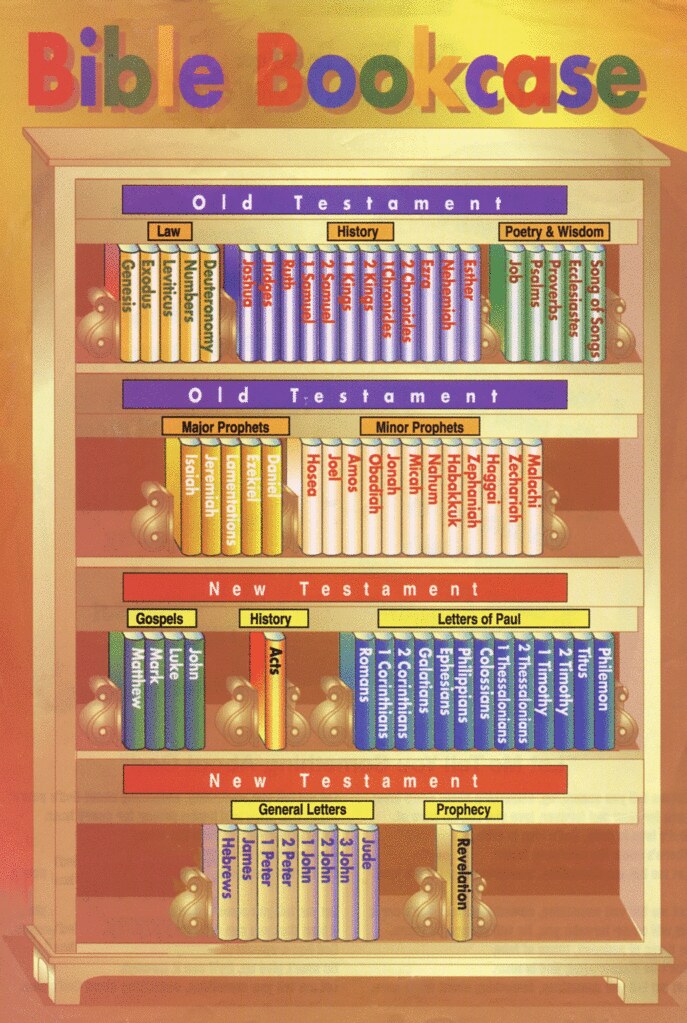
BibleBookcase

You read the last of 929 chapters and 23,261 verses of the Old Testament. It is half the Bible Book Club shelf, but it is roughly 70% of the entire Bible! It has been a challenging read, and I am proud of you for your diligent reading of God's Word.

You might like to start reading about the birth of Jesus now or wait to start on January 1. You also have the option of reading the Gospels separately or combining them with the chronological story of the life of Jesus through the Gospel Harmony Book Club. 

The New Testament is a much slower pace taking 10 months. 

Then you have the option of continuing:

November is a BBC Review using the Jesse Tree.
December is a Scarlet Thread of Redemption review using Handel's Messiah.  

CONGRATULATIONS!

Put Malachi Back on the Prophets Shelf

BibleBookcase

We are done with the entire prophets shelf! WOOHOO!